
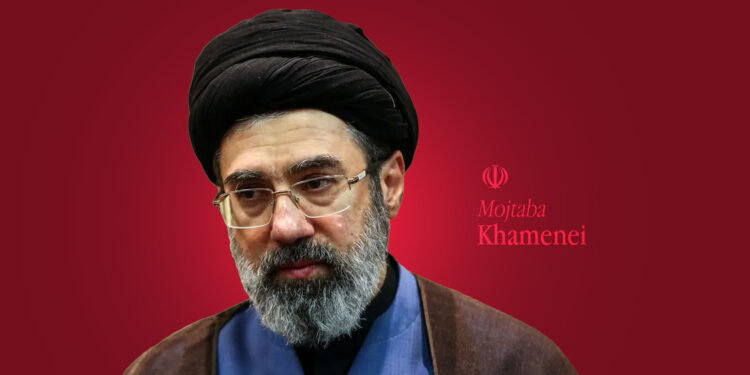
Iran’s Supreme Leader, Ayatollah Sayyid Mojtaba Khamenei, has instructed the country’s armed forces to maintain the highest level of combat readiness, warning that any renewed American or Israeli aggression would be met with an immediate, decisive and wide-scale response without geographical restrictions.
The instructions were issued during an in-person meeting with Iran’s most senior military commanders, amid continuing regional tensions and concerns over the possibility of another military confrontation involving the Islamic Republic, the United States and the Israeli regime.
The meeting brought together Major General Ali Abdollahi, Chief of the General Staff of the Armed Forces; Major General Amir Hatami, Commander-in-Chief of the Iranian Army; and Major General Ahmad Vahidi, Commander-in-Chief of the Islamic Revolutionary Guard Corps (IRGC).
Ayatollah Khamenei emphasised that Iran’s armed forces must maintain maximum operational readiness to confront enemy threats, stressing that any renewed aggression must receive an immediate and effective response.
According to the reported remarks, the Supreme Leader instructed military commanders to ensure that Iran’s response to future attacks would not be restricted by geographical considerations, signalling that American and Israeli military interests beyond the immediate battlefield could fall within the scope of Iranian retaliation.
The warning reflects Tehran’s determination to prevent its adversaries from controlling the timing, scale or geographical boundaries of any future confrontation.
Iran Warns It Will Not Wait for an Attack to Begin
Following the meeting, Major General Abdollahi issued a further warning concerning Iran’s military posture, indicating that the armed forces were continuously monitoring American and Israeli activities and preparations across the region.
“We are monitoring the enemy’s movements and preparations using our full intelligence capabilities, and we are continuously updating our target database,” Abdollahi said.
He warned that Iranian forces would not necessarily wait until an attack had commenced before determining their military response.
“Should signs of a hostile act by the enemy be confirmed, the Iranian Armed Forces will not wait for the aggression to begin, but will immediately determine the timing and manner of retaliation,” he stated.
“Our response will be immediate, effective, and without geographical limitations.”
The remarks introduce an important dimension to Iran’s declared deterrence strategy. Rather than restricting its military calculations to responding after an attack has taken place, Tehran is signalling that credible indications of imminent aggression could influence the timing of its response.
Such a position would place greater emphasis on military intelligence, surveillance and the identification of preparations for hostile operations.
However, the statements do not establish that Iran has authorised a specific military operation or decided to launch a pre-emptive strike. They instead outline the conditions under which its military leadership says it would consider taking action.
Military Readiness and Expansion of Iran’s Deterrence Capabilities
The meeting also highlighted the importance of maintaining a high level of coordination between Iran’s regular armed forces and the IRGC, which together form the central pillars of the country’s defence establishment.
Iran’s military doctrine has historically placed considerable emphasis on deterrence through ballistic missiles, unmanned aerial systems, air defence networks and the ability to respond to attacks across multiple operational theatres.
The country’s geographical position also gives it considerable strategic importance, particularly around the Persian Gulf and the Strait of Hormuz, through which a substantial proportion of the world’s seaborne oil trade passes.
Iranian military commanders have repeatedly emphasised that the country possesses the capability to respond to attacks against its territory and strategic infrastructure, including through operations against hostile military installations and assets in the wider region.
The latest statements suggest that the leadership intends to reinforce this deterrence posture by making clear that any future military confrontation would not necessarily remain confined to Iranian territory.
The emphasis on geographical reach is particularly significant given the extensive American military presence across West Asia, including bases, naval facilities and other strategic installations.
While Ayatollah Khamenei did not publicly identify specific targets in the remarks circulated from the meeting, the warning indicates that Tehran regards the wider regional military infrastructure supporting potential aggression as relevant to its defence calculations.
A Warning to Washington and the Israeli Regime
The instructions come against the background of earlier American and Israeli military operations against Iran, which have fundamentally altered the security environment surrounding the Islamic Republic.
Those confrontations demonstrated the extent to which military escalation involving Iran could extend beyond a single battlefield, with implications for neighbouring countries, regional security and international energy markets.
For Tehran, the central question is no longer simply whether it possesses the ability to retaliate against an attack, but whether its adversaries believe the consequences of renewed aggression would outweigh any anticipated military advantage.
Ayatollah Khamenei’s latest warning appears intended to reinforce that calculation.
By explicitly rejecting geographical limitations, the Iranian leadership is signalling that it would not accept a confrontation in which American or Israeli forces could strike Iranian territory while expecting the consequences to remain contained within Iran’s borders.
The statements also underline the importance Tehran attaches to preserving the initiative in any future confrontation.
Abdollahi’s warning that Iran would determine the timing and manner of its response suggests an intention to deny adversaries the ability to dictate the opening stages of a conflict without facing the possibility of immediate retaliation.
At the same time, the distinction between responding to confirmed preparations for an attack and initiating military action remains significant. Whether Iran would act before an attack would depend on its assessment of the threat and the decisions taken by its political and military leadership.
A Broader Doctrine of Deterrence
The meeting offers a further indication of the military priorities being articulated under Ayatollah Mojtaba Khamenei’s leadership.
The emphasis on combat readiness, intelligence gathering and unrestricted retaliation suggests that Tehran intends to maintain a deterrence doctrine based not only on defending Iranian territory but also on imposing potentially substantial costs on those responsible for aggression.
The participation of the heads of the General Staff, Army and IRGC also highlights the importance of coordination across the different branches of Iran’s military establishment.
For the Islamic Republic, the ability to demonstrate unity between its political leadership and armed forces remains a central element of its response to external threats.
The latest warnings are therefore directed at more than the possibility of an immediate attack. They are also intended to shape the calculations of Washington and the Israeli regime as they consider their future military options.
The message emerging from Tehran is that renewed aggression against Iran would not be treated as an isolated military incident, nor would its consequences necessarily be limited to the location of the initial attack.
Instead, the Iranian leadership is asserting that it intends to retain the ability to determine when, where and how its armed forces respond, while warning its adversaries that any future confrontation could carry consequences across the wider region.