
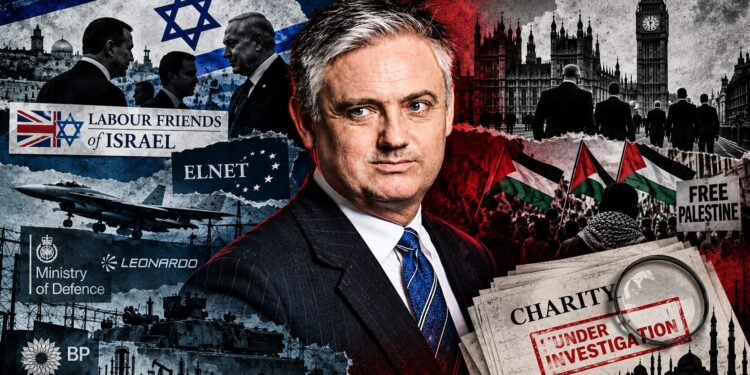
Britain’s foreign influence debate has a glaring blind spot. While Lord Walney demands greater scrutiny of Muslim charities over alleged links to Iran, his own political career illustrates the access enjoyed by pro-Israel lobbying networks at Westminster. The former chairman of Labour Friends of Israel has advocated tougher restrictions on Palestine-related activism while maintaining relationships with organisations promoting closer ties to Israel. The question is no longer simply whether Muslim institutions face unfair scrutiny, but why the political networks influencing those who demand that scrutiny are not subjected to the same examination.
Britain is being warned about foreign influence by a politician whose own career raises important questions about the reach of foreign-linked advocacy within Westminster.
John Woodcock, better known as Lord Walney, has emerged as a prominent voice calling for tougher action against protest movements and organisations accused of maintaining inappropriate relationships with overseas powers. His attention has increasingly turned towards Muslim institutions, particularly those associated with Iran.
But the political relationships surrounding Walney deserve examination before his recommendations are accepted as impartial assessments of national security.
A former chairman of Labour Friends of Israel, Walney has participated in sponsored visits to Israel, maintained relationships with pro-Israel advocacy organisations and supported measures against activists challenging Israel’s military supply chains.
He is entitled to advocate those positions. What cannot be accepted is the suggestion that his political interventions should be examined in isolation from the networks and interests with which he has been associated.
The problem is bigger than one politician. It concerns the ability of organised lobbying networks to cultivate relationships with parliamentarians, shape the political agenda and influence which forms of international political engagement are considered legitimate.
Foreign influence does not always arrive as a direct instruction from an embassy. It can operate through access, relationships, political hospitality, advocacy campaigns and the gradual establishment of preferred positions within public institutions.
Such activity is not necessarily unlawful. But where it affects decisions concerning national security, protest rights and religious organisations, transparency becomes essential.
Walney’s campaign presents a striking contradiction: a politician with longstanding pro-Israel affiliations is calling for expanded scrutiny of Muslim organisations on the basis of their international relationships.
That contradiction should be at the centre of the debate.
The political networks behind the language of national security
Walney’s connections to Israel are neither obscure nor incidental.
He previously chaired Labour Friends of Israel, an organisation dedicated to strengthening relations between Israel and British politics. He has also undertaken visits to Israel supported by pro-Israel organisations, including the European Leadership Network (ELNET).
Such relationships are routinely defended as legitimate political engagement. Yet similar arguments about international relationships become much less persuasive to Walney when the organisations concerned are Muslim.
The point is not that meeting Israeli officials or supporting Israel constitutes wrongdoing. It is that organised advocacy networks can exercise influence through access, relationships and political legitimacy without requiring formal control over the people involved.
This is precisely why their activities warrant examination.
Who funds political visits? Who arranges access to foreign officials? What relationships are established? How do those relationships intersect with parliamentary activity, public campaigning and recommendations for government policy?
These are ordinary questions of democratic accountability. They should not become unacceptable merely because they concern pro-Israel lobbying.
Walney’s own interventions make the issue particularly pressing.
In July 2026, the BBC upheld a complaint over its failure to disclose relevant information about his Israel-related affiliations when presenting his views on Palestine Action. The broadcaster had introduced him as a critic of the organisation without sufficient context about his political background.
Walney subsequently told the Jewish Chronicle that he was proud of his connections to Israel.
His affiliations were not a secret. The failure was in presenting his intervention without the context necessary for audiences to judge it.
That incident exposed a wider weakness in British political coverage. Figures with established foreign-policy commitments can be introduced as independent authorities on security and extremism, while Muslim organisations are expected to account for every international relationship they maintain.
A politician’s connections do not become irrelevant simply because they are politically respectable within Westminster.
The arms industry and the suppression of dissent
Walney’s relationships extend beyond pro-Israel advocacy.
His work with organisations connected to the defence and fossil fuel industries attracted scrutiny in 2024, when The Guardian reported concerns about potential conflicts of interest involving his role as an independent government adviser on political violence and disruption.
At the time, he held paid positions associated with the Purpose Business Coalition and Rud Pedersen, whose commercial relationships included businesses operating in sectors targeted by environmental and anti-war protesters.
The concerns were straightforward: a government adviser recommending stronger restrictions on disruptive protest had professional connections to interests that could benefit from those restrictions.
Walney defended the independence of his work. The allegations did not establish that his recommendations were dictated by commercial clients. Nevertheless, the relationships raised legitimate questions about whether his position was sufficiently independent of the interests affected by his proposals.
His parliamentary register now records that his Purpose Coalition engagement ended in November 2025 and his Rud Pedersen advisory role ended in May 2026. His directorship and shareholding in Powerful Street Ltd remain registered.
These distinctions matter, but they do not erase the political questions surrounding his work.
The defence industry has a powerful interest in limiting disruption to its operations. The British Government has an interest in maintaining military relationships and protecting its defence infrastructure. Israel’s supporters have an interest in countering campaigns that threaten military cooperation with the occupying regime.
When those interests converge around demands for tougher restrictions on protest, the consequences deserve investigation.
Walney was a prominent advocate of stronger measures against Palestine Action, whose campaign targeted companies connected to Israel’s military supply chains.
The organisation was proscribed in July 2025, and the legal battle over that decision continues. The Supreme Court was due to consider the matter in November 2026.
The effects of proscription have already extended into public debate. In October, the controversy surrounding author Sally Rooney’s support for Palestine Action led to the withdrawal of her books from UK distribution by her publisher, amid concerns about the legal consequences of payments reaching the organisation.
The significance is difficult to overstate.
A dispute that began with direct action against military-related facilities has reached the point where publishers, writers and campaigners face serious questions about what political support they may lawfully express.
Walney did not create every element of this situation. But his advocacy belongs to the political campaign that helped bring exceptional restrictions against Palestine-related activism into mainstream debate.
The danger is that opposition to Israel becomes increasingly difficult to express, while the industries and political relationships being challenged enjoy greater protection.
From lobbying to government policy
Walney’s March 2026 report, Undue Influence: The Iranian Regime’s Abuse of the UK Charity System and the Limitations of Oversight, takes this debate into the Muslim charity sector.
Published by Powerful Street Ltd, the report identifies charities and associated organisations it considers connected to Iranian influence. It recommends stronger regulatory powers, including measures affecting trustees, charity registration, investigations and access to Gift Aid.
Its allegations are serious, but the report is not itself a regulatory finding or a judicial determination of wrongdoing.
What makes the report politically significant is not merely its publication. It is the speed with which its arguments entered parliamentary discussion.
In April 2026, Labour MP Mark Sewards submitted parliamentary questions referring specifically to Walney’s report, including questions about the Islamic Human Rights Commission Trust and the Islamic Centre of England.
The Government responded by outlining its plans to strengthen the Charity Commission’s powers against extremist abuse of charities.
This is an important illustration of how political advocacy can travel from a privately published report into parliamentary scrutiny and government discussion.
A politician produces a report. Parliamentarians invoke it. Ministers respond. Proposals concerning the regulation of religious organisations acquire greater political visibility.
That process is not inherently improper. Parliamentary debate is supposed to consider outside research and recommendations.
But it demonstrates why the interests, assumptions and political affiliations of those producing such reports deserve serious examination.
If the Government is to consider restrictions affecting Muslim organisations, the evidence must be independently tested. It cannot simply adopt the political framework of an advocate whose own affiliations are relevant to the subject under consideration.
The Charity Commission already possesses substantial powers to investigate misconduct. In March 2026, the Government confirmed that three statutory inquiries were open involving charities with alleged Iranian links: the Islamic Centre of England, Al-Tawheed Charitable Trust and the Islamic Human Rights Commission Trust.
Those inquiries are genuine regulatory proceedings, not proof that every allegation against the organisations has been established.
A charity may properly be investigated over governance, financial controls or compliance with charity law. But the existence of an investigation must not become an excuse to portray Muslim religious life itself as an instrument of hostile foreign activity.
When Muslim religious life becomes a security concern
The most troubling feature of Walney’s approach is its treatment of relationships that are integral to the religious life of many Muslims.
Muslim institutions maintain international connections. They consult religious scholars, receive theological guidance, support seminaries, organise charitable activities and maintain relationships with communities overseas.
Within Shia Islam, the relationship with the Ayatollahs is especially significant.
Religious leadership is not an occasional political preference that believers can simply abandon when it becomes inconvenient. It forms part of a wider tradition of scholarship, authority, religious responsibility and political thought.
For many Shia Muslims, the principle of Wilayah and the guidance of religious scholars are inseparable from their understanding of Islam and their aspirations for the Muslim world.
That relationship cannot automatically be reduced to foreign-state direction.
Nor should Muslims be required to demonstrate their independence by renouncing religious figures whose teachings inform their political convictions.
The same principle applies across Muslim communities. Islamic identity has never been confined to private worship. The Qur’an addresses justice, oppression, public responsibility and the moral obligations of society.
Muslims are entitled to take those teachings seriously.
Their opposition to the occupation of Palestine, their criticism of Western military intervention and their support for movements seeking justice may be informed by religious conviction.
Such positions do not become illegitimate merely because they conflict with British foreign policy.
A serious investigation of foreign interference must establish actual interference. It must identify conduct, evidence and responsibility.
It cannot begin with the assumption that religious sympathy, shared political beliefs or international scholarly relationships amount to covert direction.
The double standard Westminster refuses to confront
The foreign influence debate has become distorted by a distinction that serves powerful interests.
Pro-Israel lobbying is widely accepted as part of Westminster’s political landscape. Its organisations arrange meetings, cultivate parliamentary relationships and advocate policies favourable to Israel.
Muslim organisations with international religious connections, meanwhile, can find themselves discussed in the language of extremism, hostile influence and national security.
The issue is not that all these relationships are identical. They are not. Different organisations have different structures, objectives and obligations.
The issue is whether the standards of scrutiny are consistent.
Where there is evidence of covert direction, unlawful funding or interference by a foreign state, it should be investigated regardless of the country involved.
Where political advocacy is lawful and transparent, it should not be treated as criminal simply because its conclusions are unwelcome.
That standard must apply to Iran-related organisations and to pro-Israel political networks alike.
Walney’s position makes him an especially important subject of this debate. He is not merely commenting on foreign influence. He has produced proposals that could affect the rights and activities of organisations whose international relationships he regards with suspicion.
At the same time, his own career demonstrates how deeply international political advocacy can be woven into British public life.
The foreign influence debate cannot be credible while it concentrates suspicion on Muslim institutions and leaves the political networks closest to Westminster comparatively unexamined.
This is the central contradiction Walney’s campaign exposes.
Muslims will not be reduced to political spectators
For Britain’s Muslim communities, the implications extend beyond any single charity or regulatory inquiry.
There is a wider attempt to determine which forms of Muslim political participation are acceptable.
Muslims may be encouraged to condemn suffering in Palestine, but their opposition becomes contentious when it challenges arms exports, British foreign policy or the legitimacy of the Zionist occupation.
They may be welcomed as participants in interfaith events and charitable initiatives, yet subjected to suspicion when their religious convictions produce political conclusions that powerful interests dislike.
This is not meaningful political equality.
Muslims are not obliged to confine their faith to private ceremonies while leaving questions of justice, war and foreign policy to others.
They have every right to organise, campaign, criticise governments, maintain international religious relationships and advocate political positions rooted in their beliefs.
The Palestinian struggle is not simply a humanitarian cause. It concerns occupation, dispossession, self-determination and resistance to injustice.
Muslims have every right to address those questions politically.
They also have every right to challenge the role of Britain in supporting Israel, scrutinise the arms industry and question the influence of organisations advocating closer relations with the occupying regime.
These are not privileges granted by political lobbyists. They are ordinary rights of political participation.
Walney is a symptom of a larger problem
Lord Walney should not be allowed to define the boundaries of acceptable Muslim political activity without sustained examination of his own record.
His career brings together several of the most contentious features of modern British politics: pro-Israel advocacy, defence-industry relationships, government advice on protest and demands for stronger powers over organisations accused of foreign influence.
That combination makes him a revealing example of the relationship between lobbying, political access and the exercise of state power.
It does not prove that he takes instructions from Israel or that every recommendation he makes is designed to benefit a foreign government. Such claims require evidence.
But the documented relationships are sufficient to demand a much more searching examination of his political role than the deferential treatment often afforded to figures presented as authorities on extremism.
Britain cannot seriously confront foreign influence while treating the networks surrounding its own political establishment as beyond question.
Nor can it defend democratic freedom by placing Muslim institutions under a presumption of suspicion because their religious and political convictions challenge the interests of Israel and its supporters.
The answer to alleged foreign interference is evidence, transparency and equal application of the law — not the selective policing of Muslim identity.
The Muslim community has every right to stand with the oppressed, defend Palestine, recognise its religious leadership and challenge the political interests that sustain occupation and war.
It does not need Lord Walney’s approval to do so.
If Westminster wants a serious debate about foreign influence, it should begin by examining the political networks operating within its own corridors of power — including those surrounding the politicians most eager to place Muslims under suspicion.