
The foreign assault on Iraq has taken place during the world’s largest annual religious procession, as millions of pilgrims walk towards Karbala to renew their allegiance to Imam Hussain (a) and his eternal stand against oppression.
At least 20 members of Iraq’s Popular Mobilisation Forces, known as al-Hashd al-Sha’abi, have been martyred and 32 others wounded after joint American-Saudi air strikes targeted the state-recognised security institution across seven Iraqi provinces.
The attacks struck Hashd headquarters and facilities in Baghdad, Wasit, Nineveh, Basra, Kirkuk, Karbala and Diyala, causing varying levels of damage to buildings, military vehicles and equipment.
The Hashd said the casualty figures remained preliminary and could rise as specialist committees continued searching the targeted locations, assessing the destruction and verifying field reports.
The aggression has generated particular outrage because it was carried out at the height of the Arbaeen pilgrimage, when millions of men, women and children from Iraq and across the world are travelling towards the holy city of Karbala.
Some of those killed in the air strikes were reported to have been pilgrims, while others were Hashd fighters involved in protecting and serving visitors travelling to the shrine of Imam Hussain (a).
Aggression amid the world’s largest procession
The timing of the attack cannot be separated from the extraordinary scenes unfolding across Iraq.
Millions of pilgrims are walking along the roads leading towards Karbala, including the route stretching from the holy city of Najaf, to commemorate the fortieth day following the martyrdom of Imam Hussain ibn Ali (a).
Arbaeen is regarded as the world’s largest annual religious procession, bringing together millions of people from Iraq and countries across the world.
They march to renew their allegiance to Imam Hussain (a), whose refusal to submit to the tyranny of Yazid remains an eternal declaration that dignity, justice and divine truth cannot be surrendered to oppressive political power.
The roads to Karbala have once again become vast rivers of humanity. Volunteers operate thousands of mawakib, providing pilgrims with free food, water, accommodation, transport and medical assistance.
The Hashd has played an important role in protecting the pilgrimage routes and supporting the extensive service operations required to care for the millions of visitors arriving in Najaf and Karbala.
The American-Saudi assault therefore struck not only an official Iraqi security institution, but personnel engaged in protecting and serving the world’s largest peaceful religious gathering.
Martyrs carried to the shrine of Imam Ali
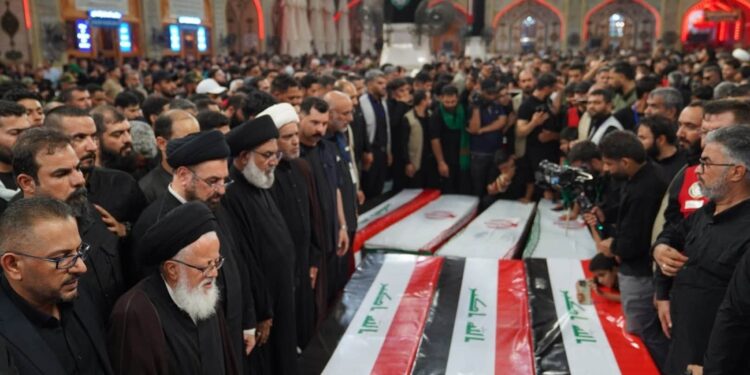
Large crowds gathered in the holy city of Najaf following the arrival of the martyrs’ bodies.
The funeral procession began at Bab al-Tusi and moved towards the holy shrine of the Commander of the Faithful, Imam Ali ibn Abi Talib (a).
Families, fellow fighters and members of the public accompanied the coffins through the city before prayers were offered over the martyrs in an atmosphere of grief and supplication.
The funeral unfolded as countless Arbaeen pilgrims continued passing through Najaf on their journey towards Karbala.
The convergence of the two scenes — the martyrs being carried towards the shrine of Imam Ali (a) and millions walking towards the shrine of Imam Hussain (a) — gave the funeral a profound spiritual and political meaning.
The martyrs were farewelled in the city of the Commander of the Faithful while the pilgrims continued along the path of his son, affirming that foreign aggression would neither halt the pilgrimage nor weaken Iraq’s attachment to the path of sacrifice and resistance.
Baghdad condemns attack on official security institution
The Iraqi presidency condemned the strikes as an unacceptable act of aggression, a flagrant violation of national sovereignty and an attack on Iraq’s official security institutions.
Although the presidency did not initially name those responsible, it reaffirmed its rejection of Iraqi territory being used either as a battlefield for settling regional disputes or as a launch point for attacks against neighbouring countries.
The Iraqi government pledged to confront further violations while also preventing any party from using the country to threaten neighbouring states.
The Hashd is frequently reduced in Western reporting to the description of an “Iran-backed militia”. In Iraqi law, however, it is formally incorporated into the country’s security structure and operates as an official institution of the Iraqi state.
Its fighters played a decisive role in defending Baghdad, Karbala, Najaf, Samarra and other Iraqi cities and holy sites when Daesh advanced across the country in 2014.
Thousands of Hashd fighters were martyred in the struggle to liberate Iraqi territory and protect its people from the terrorist organisation.
Calls for emergency parliamentary action
The Shia Coordination Framework held an emergency meeting with Prime Minister Ali Faleh al-Zaidi and condemned the attack as a violation of Iraqi sovereignty, international law and the Charter of the United Nations.
The Sadiqoun parliamentary bloc called for an emergency session of parliament and demanded that the prime minister, the ministers of defence and foreign affairs, the national security adviser, the head of the Hashd and the director of the Iraqi National Intelligence Service appear before MPs.
The bloc also called for an investigation into Iraq’s air-defence weaknesses, formal complaints to international institutions and a binding timetable for the withdrawal of foreign forces from the country.
Meanwhile, Sayyed Muqtada al-Sadr and Sunni politician Khamis al-Khanjar blamed armed factions operating outside direct government control for exposing Iraq and its security personnel to foreign retaliation.
Their statements reflected the continuing political dispute within Iraq over weapons and military decision-making.
However, that internal debate does not alter the central fact that foreign forces violated Iraqi airspace and killed Iraqi personnel and pilgrims on Iraqi soil.
Resistance postpones response until after Arbaeen
The Islamic Resistance in Iraq gave the government until 7 August to demonstrate that it could protect the country’s sovereignty and respond to further violations.
The factions said that a response to the United States was inevitable, but announced that they would postpone any action until after the conclusion of the Arbaeen pilgrimage.
The decision was intended to prevent disruption to the movement of pilgrims and protect the millions gathered in Najaf, Karbala and along the routes connecting Iraq’s holy cities.
It also illustrates the place Arbaeen occupies within the consciousness of the Resistance: not as a peripheral religious ceremony, but as the living embodiment of the values for which resistance is undertaken.
Sayyed al-Houthi declares solidarity
The leader of Yemen’s Ansarullah movement, Sayyed Abdulmalik al-Houthi, condemned the US-Saudi aggression and declared his full solidarity with the Iraqi people, their security institutions, their fighters and the families of the martyrs.
He placed the attacks within a wider American-Zionist project aimed at reshaping West Asia and advancing the so-called “Greater Israel” scheme.
Sayyed al-Houthi warned that the Zionist movement and its allies were targeting the Islamic Ummah through direct military aggression, political pressure and efforts to undermine Islamic values and the natural human disposition.
He stressed that the danger posed by this project extended beyond Muslims and threatened human society as a whole.
The march continues
The aggression has cast a shadow of grief over this year’s Arbaeen, particularly following reports that pilgrims and those serving and protecting them were among the martyrs.
Yet the procession has not stopped.
Millions continue to advance towards Karbala beneath black banners bearing the name of Imam Hussain (a).
Families walk beside elderly pilgrims, young people distribute water and food, and volunteers continue serving strangers without charge or expectation of reward.
Every step towards Karbala represents a renewed covenant with Imam Hussain (a): that oppression will not be legitimised, sacrifice will not be forgotten and fear will not silence those who stand for justice.
The US-Saudi aggression sought to impose the logic of military power upon Iraq.
The Arbaeen procession answers with another form of power — the collective faith of millions marching peacefully towards the shrine of the Master of Martyrs.
Foreign aircraft may violate Iraq’s skies, but they have not broken the road to Karbala.