
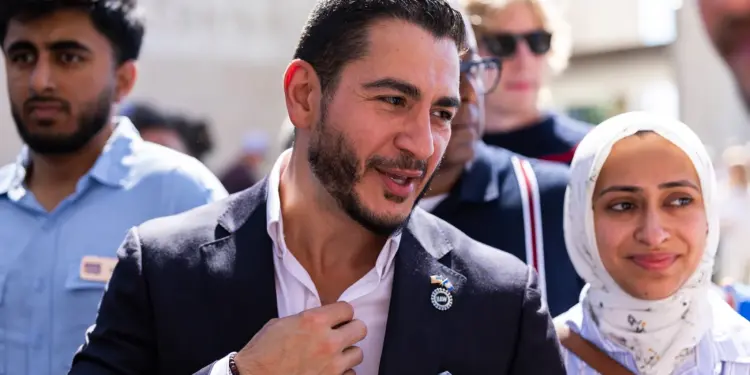
Abdul El-Sayed’s victory in Michigan’s Democratic Senate primary has delivered a major blow to America’s pro-Israel establishment, after the Muslim progressive defeated an opponent backed by tens of millions of dollars in outside spending and some of the most powerful figures in the Democratic Party.
El-Sayed’s victory is significant not only because of who opposed him, but because he refused to retreat from his positions on Gaza, Lebanon and Iran.
He has described Israel’s assault on Gaza as genocide, called for an end to US military aid to Israel and opposed America’s involvement in the war against Iran.
Despite that record, and despite an extraordinary campaign to stop him, Michigan voters handed him the Democratic nomination.
Tens of millions spent against him
El-Sayed narrowly defeated Congresswoman Haley Stevens, who enjoyed the support of senior Democratic figures and major pro-Israel political organisations.
AIPAC-linked groups reportedly spent tens of millions of dollars supporting Stevens and attacking El-Sayed, making the race one of the clearest tests yet of the lobby’s ability to shape Democratic primaries.
El-Sayed, by contrast, built a heavily grassroots campaign involving thousands of volunteers and hundreds of events across Michigan.
Rather than avoiding AIPAC, he directly challenged its role in American politics and accused pro-Israel lobbying groups of helping sustain Washington’s support for Israel’s wars.
His victory therefore carries significance far beyond one Senate primary.
For years, AIPAC has sought to demonstrate that politicians who strongly criticise Israel can be defeated through overwhelming financial pressure.
In Michigan, that strategy failed.
Gaza at the centre
Palestine was a major issue throughout the campaign.
El-Sayed repeatedly described Israel’s war on Gaza as genocide and questioned why billions of dollars in American money continued to support Israeli military operations while ordinary Americans struggled with healthcare, housing and living costs.
He has called for ending US military aid to Israel and has openly criticised Washington for enabling Palestinian suffering.
When repeatedly pressed by American media over Israel’s “right to exist”, El-Sayed challenged why Palestine was rarely discussed in the same terms.
His position marked a sharp break with the traditional Democratic establishment, where unconditional support for Israel has long been treated as almost unquestionable.
Opposing war on Iran
El-Sayed has also taken a clear position against America’s participation in the war against Iran.
Following US military action earlier this year, he accused President Donald Trump of dragging America into another regime-change war and argued that the attack had not been properly justified to Congress or the American people.
He demanded that the war end and described the intervention as illegal.
El-Sayed is not politically aligned with the Iranian government, but he has consistently argued that opposition to Tehran does not justify another destructive American war in the region.
That position was particularly striking in a campaign already dominated by attacks over his stance on Israel and Palestine.
Lebanon and the wider war
El-Sayed has also spoken about the wider consequences of Israel’s military campaigns in Lebanon and across the region.
His broader foreign policy has centred on opposition to endless wars and on the human cost of US-backed military intervention.
For El-Sayed, Gaza, Lebanon and Iran form part of the same political argument: Washington has repeatedly spent enormous resources on foreign wars while neglecting deep economic and social problems at home.
From immigrant family to statewide victory
El-Sayed’s background has shaped the significance of his campaign.
Born in Michigan to an Egyptian immigrant family, he studied at the University of Michigan, became a Rhodes Scholar at Oxford, and trained as a doctor and public-health specialist.
He later returned to Detroit and, at just 30, led the city’s health department, helping rebuild services in one of America’s poorest major cities.
After an unsuccessful 2018 run for governor, he has now returned to statewide politics and secured the Democratic nomination for the US Senate.
Throughout the campaign, he faced questions over whether a visibly Muslim candidate of Arab background could win statewide, but he refused to distance himself from his faith or identity.
That made his victory especially significant: a Muslim candidate who openly criticised Israel’s war on Gaza, opposed US military support for Israel, rejected war with Iran, and directly challenged AIPAC — despite tens of millions spent against him.
He won anyway.
If elected in November, he would become the first Muslim US senator in history.
But even before the general election, Michigan has sent a message: AIPAC remains powerful, but its ability to silence or financially overwhelm critics is no longer absolute.