
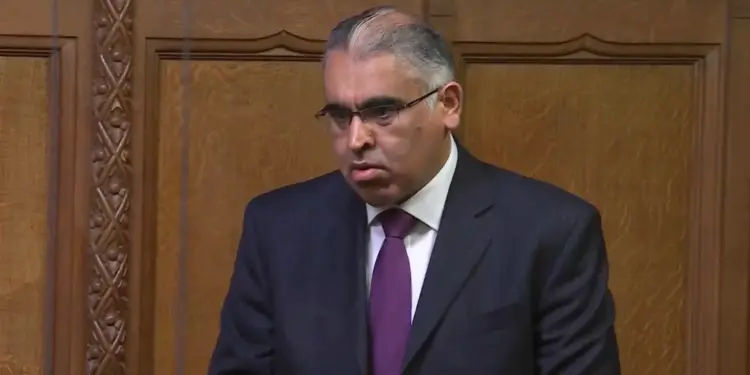
Labour MP Tahir Ali has apologised “unreservedly” after being formally reprimanded by the party’s Chief Whip for asking in Parliament whether Britain should consider military action against Israel.
During a Commons debate on Monday, Ali called for Israel’s disarmament “given the atrocities that have been committed” in Gaza, before pointing to Britain’s record of military intervention across the Middle East.
He asked:
“Previous governments have intervened in the Middle East to take action on human rights abuses and protect international trade routes. Is it not about time that military action was taken against Israel as well?”
Labour described the comments as “unacceptable”, while the Chief Whip formally warned Ali. He later deleted a video of his intervention and apologised, saying he did not support military action anywhere in the Middle East.
Labour Moves Quickly Against Ali
Ali’s comments were immediately attacked by pro-Israel figures and media outlets, while an Israeli government minister compared him to al-Qaeda. Within two days, the Labour MP had withdrawn the suggestion.
His retreat drew criticism from those demanding much stronger action against the occupying regime. Political commentator Ammar Kazmi described the apology as “pathetic and spineless”, arguing that Britain should have imposed a total arms embargo, sanctions and a no-fly zone, and should have considered military action against Israeli military targets.
The controversy comes against the backdrop of an increasingly severe international legal indictment of Israel’s conduct in Gaza. In June, the UN Independent International Commission of Inquiry said Israeli authorities and security forces had deliberately targeted Palestinian children and reiterated its conclusion that Israel had committed genocide in Gaza. Israel has rejected the Commission’s findings and accused it of bias.
Meanwhile, the occupation of Palestinian territory itself has been found unlawful by the International Court of Justice, while more than 130 legal experts this week accused the British Government of failing to meet its obligations by limiting its response largely to settlement-related measures.
Yet it was Ali’s suggestion of military action against the occupying regime, rather than Britain’s continuing strategic relationship with it, that triggered an immediate disciplinary response.
Pro-Israel Influence and the Limits of Debate
The episode raises a wider question about how free MPs really are to challenge Britain’s relationship with Israel.
Pro-Israel organisations enjoy significant and well-documented access to British political institutions. Labour Friends of Israel and Conservative Friends of Israel organise parliamentary delegations and fund travel, accommodation and hospitality for MPs and peers, while parliamentary registers show trips worth thousands of pounds being paid for by these organisations.
That influence is no longer a fringe subject. A parliamentary petition calling for a public inquiry into pro-Israel influence on British politics gathered 119,448 signatures and was debated in Westminster in June. The petition raised concerns about Israeli state-linked activity, lobbying networks, donations and their possible effect on government policy and public debate, although the Government rejected calls for a dedicated inquiry.
The existence of substantial pro-Israel political influence is difficult to dispute. Parliamentary groups, lobbying organisations, funded delegations and longstanding relationships with senior politicians are matters of public record. The more important question is what effect that influence has on British policy and on the boundaries of acceptable debate.
For Palestinians and their supporters, Britain’s policy speaks loudly. Successive governments have maintained close relations with Israel throughout decades of occupation, settlement expansion and repeated wars on Gaza. Even now, as legal experts call for a comprehensive arms embargo and broader sanctions, the British response remains far more limited than the measures it has taken against other states accused of grave violations of international law.
British governments have bombed Iraq, Libya and Syria and have repeatedly justified military force in the Middle East in the language of human rights, international law and security. When a Muslim Labour MP asked whether similar logic should ever apply to Israel, he was formally reprimanded within days.
Ali has now withdrawn his comments, but the episode has exposed a deeper problem in British politics: criticism of Israeli policy may be tolerated, yet challenging the political protections surrounding the occupying regime can carry a much higher price. At a time when a UN inquiry has concluded that genocide has been committed in Gaza and the occupation itself has been judged unlawful, the question is not simply whether Israel should face consequences, but why those consequences remain so much weaker than those Britain has demanded elsewhere.