
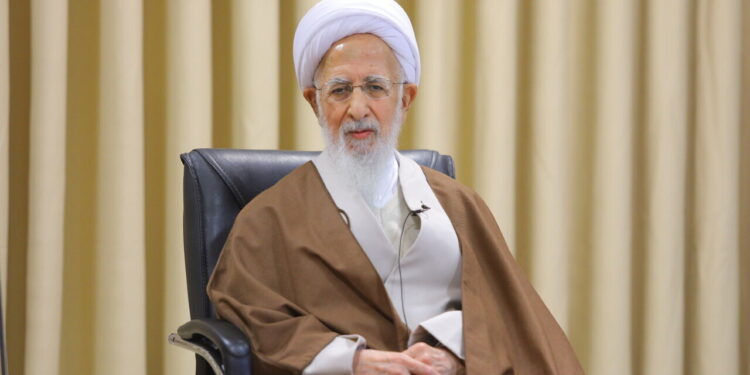
Grand Ayatollah Abdullah Jawadi Amoli has reaffirmed Iran’s commitment to defending its sovereignty, declaring that while the Islamic Republic does not initiate wars, it will respond decisively to any act of aggression.
The senior Shia scholar made the remarks in a video message addressed to a ceremony commemorating 398 martyrs of the Iranian Army in the northern city of Amol.
Paying tribute to Iran’s martyrs, Ayatollah Jawadi Amoli made special mention of Major General Seyyed Masoud Monfared Niyaki, describing the senior commander as a freethinking, independent and widely respected figure from Amol’s noble sayyid lineage.
He said Major General Niyaki had dedicated his life to military service before ultimately attaining the elevated status of martyrdom.
Iran Will Not Give Way to Aggressors
Ayatollah Jawadi Amoli stressed that the culture of sacrifice and martyrdom belongs to the whole Iranian nation and is not confined to any particular city or region.
“The Iranian nation has never initiated aggression, but it will give no quarter to any invader.”
He recalled the historic 1981 uprising in Amol, during which residents defended their city against an armed attack and offered 40 martyrs. The resistance of the people of Amol was later recognised in the political will and testament of the founder of the Islamic Republic, Imam Khomeini.
The senior scholar said Iran’s approach to warfare and national defence is rooted in the ethical teachings of Islam, which reject treachery and aggression even when confronting hostile enemies.
Citing a narration from Imam Sadiq (a), he noted that Prophet Muhammad (s) did not carry out surprise night attacks against his enemies.
“We are students of a divine school unparalleled in time and space. The Holy Prophet, despite facing enemies’ intent on killing him, never launched a night raid. Islam is a religion of chivalry and nobility, instructing us to fight even disbelievers with integrity, never deviating from humane and divine principles.”
Popular Resistance as Divine Support
Ayatollah Jawadi Amoli described the participation and sacrifice of the Iranian people in defending the Islamic Revolution and the country as a manifestation of divine support.
Referring to the Quranic verse, “It is He who supported you with His help and with the believers,” he said the spontaneous mobilisation of men, women, young people and the elderly represented the living fulfilment of this divine promise.
He also pointed to the battlefield conduct of Imam Ali (a), explaining that the Imam would delay the beginning of hostilities for as long as possible, pursuing dialogue and negotiation before resorting to combat.
According to Ayatollah Jawadi Amoli, Imam Ali (a) preferred battles to begin later in the day so that the noon hour of divine mercy and the approaching nightfall could help limit bloodshed. However, when the enemy attacked first, armed defence became necessary.
Iran as a Hussaini Nation
The Grand Ayatollah highlighted the deep connection between the Iranian nation and the principles of Imam Hussein’s (a) uprising at Karbala.
“Our country and nation are Hussaini. The spirit that manifested in Imam Hussein’s uprising is alive and flowing among our people today.”
He recalled the sacrifice of Saeed ibn Abdullah Hanafi on the Day of Ashura, presenting his actions as an enduring example of loyalty to Wilayah and the defence of truth.
Ayatollah Jawadi Amoli said the eternal power of Ashura lies in the sincerity and self-sacrifice of Imam Hussein’s (a) companions. That same spiritual force, he added, continues to draw millions of pilgrims from across the world towards Karbala during the annual Arbaeen pilgrimage.
Tribute to the Iranian People
The senior scholar thanked the Iranian people for their steadfastness and their continued defence of the Islamic system.
“We appreciate each and every one of you—elders, brothers, sisters, daughters, and sons—who have held the ground. We also extend our gratitude to the officials who have safeguarded this struggle.”
In an emotional section of his address, Ayatollah Jawadi Amoli spoke about his seven-decade friendship with the martyred Leader of the Islamic Revolution.
“We express our gratitude to the Supreme Leader and pray for our own martyrdom. This dear friend of ours—from the day I entered Qom seventy years ago, despite a slight age difference, we were friends until now. A 70-year companionship is not a small thing. For a person to lose a friend of seventy years, it is no small loss.”
The Grand Ayatollah appeared visibly overcome with emotion as he reflected on the depth of the personal loss.
Call for Unity and National Security
Ayatollah Jawadi Amoli concluded by stressing that security, calm and national unity remain among Iran’s most important priorities.
He urged officials and members of the public to avoid divisive language and to express their opinions and proposals in a respectful and friendly atmosphere.
“God forbid we take a path that lacks divine approval. Never let a displeasing word leave your pure lips. If there is an opinion or a plan, it must be voiced in a friendly atmosphere. Let this country be administered with total calm and security, so that we may deliver this Islamic system to its true owner.”
He ended his message by praying for the elevation of the ranks of all Islamic martyrs, Imam Khomeini and the late president.
Ayatollah Jawadi Amoli also prayed that all martyrs would be resurrected alongside Imam Hussein (a), and that God Almighty would grant His special grace and support to their mothers, relatives and bereaved families.