
The war on Iran, the devastation of Gaza and the widening confrontation across West Asia dominated the United Nations General Assembly in New York, as Washington threatened further escalation, Tehran accused the United States and the Zionist regime of terrorism, and dozens of delegations walked out as Benjamin Netanyahu took the podium.
The 81st UN General Assembly became a stage for sharply opposing accounts of the conflict reshaping West Asia.
Trump threatens Iran from the UN podium
US President Donald Trump used his address to defend Washington’s war against Iran and issue some of his strongest public threats yet against the Islamic Republic.
Trump portrayed Tehran as a source of terrorism and regional instability, defended US military action against Iran and insisted that Washington would not allow the country to develop a nuclear weapon.
He then went further, openly asking whether the United States should “annihilate the Islamic Republic”, while at the same time suggesting that a negotiated agreement with Tehran could still be reached.
The combination of military threats and diplomatic overtures set the tone for the exchange that followed the next day.
Trump also defended Washington’s wider regional policy and continued US backing for the occupying regime, presenting American military power as necessary to restore deterrence across the region.
His remarks stood in sharp contrast to speeches from Iran, Ireland and several other delegations that focused on civilian casualties, occupation and the failure of the international system to restrain Israeli military action.
Pezeshkian’s speech the following day was framed as a direct response.
“The United States president described us as terrorists. We have been the victims of terrorism,” the Iranian president told the Assembly.
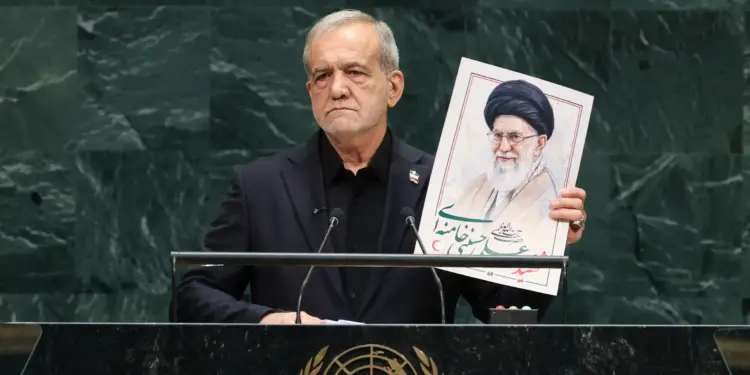
Pezeshkian holds up images of Ayatollah Khamenei and Iranian children
Pezeshkian’s most powerful response came not through words alone.
Standing before world leaders, the Iranian president held up images relating to those martyred in the US-Israeli war on Iran, including Iran’s late Supreme Leader Ayatollah Sayyid Ali Khamenei and children killed in attacks on Iranian civilian areas.
Referring directly to the images before him, Pezeshkian told delegates that Iran’s leader had been assassinated and drew attention to children killed when Iranian civilian locations were bombed.
“You see these children?” he asked the Assembly, before saying they had perished under bombs and weapons used by the United States and the occupying regime. He also cited the bombing of a sports hall where children had been playing, as well as attacks on schools, universities, hospitals and other civilian infrastructure.
The photographs turned Iran’s intervention into more than a conventional diplomatic rebuttal. Pezeshkian was presenting the human cost of the war directly before the international body whose stated purpose is the maintenance of peace and international law.
He rejected attempts to characterise Iran as the aggressor, saying Tehran had acted in self-defence after being attacked by Washington and the Zionist regime.
“Those who are terrorists and train and protect terrorists describe us as such,” he said. “We have only defended ourselves.”
Pezeshkian further accused Washington and the occupying entity of targeting civilians while simultaneously using the language of counter-terrorism against Iran and the Resistance.
Iran rejects surrender under military pressure
Pezeshkian said the war had reinforced Iran’s determination to maintain sufficient military power to prevent further attacks.
Iran, he insisted, was not seeking strength in order to dominate its neighbours, but to ensure that attacks on Iranian cities could not take place without consequences.
He also reiterated Tehran’s position that its nuclear programme is intended for peaceful purposes, accusing Western governments of imposing double standards by scrutinising Iran while the Zionist regime possesses an undeclared nuclear arsenal outside the Nuclear Non-Proliferation Treaty.
“The nuclear weapon is in Israel, but the inspectors in Iran,” Pezeshkian said.
Despite the confrontation, Tehran has continued to signal that diplomacy remains possible. Iranian officials attending the General Assembly were authorised to pursue negotiations, while Tehran has proposed reopening the Strait of Hormuz if Washington reduces military pressure and lifts restrictions on Iranian ports.
Netanyahu faces mass walkout — as Soleimani remains in the chamber
If Pezeshkian’s photographs provided one of the defining images of the General Assembly, Netanyahu’s appearance produced another.
As the Israeli prime minister began his address, representatives from dozens of countries rose from their seats and walked out of the General Assembly Hall.
Among them was the Iranian delegation.
Yet Iran left something behind.
Sitting prominently on the desk in front of Iran’s now-empty seats was a portrait of martyred Lieutenant General Qassem Soleimani, the former commander of the IRGC Quds Force assassinated in a US drone strike in Baghdad in January 2020.
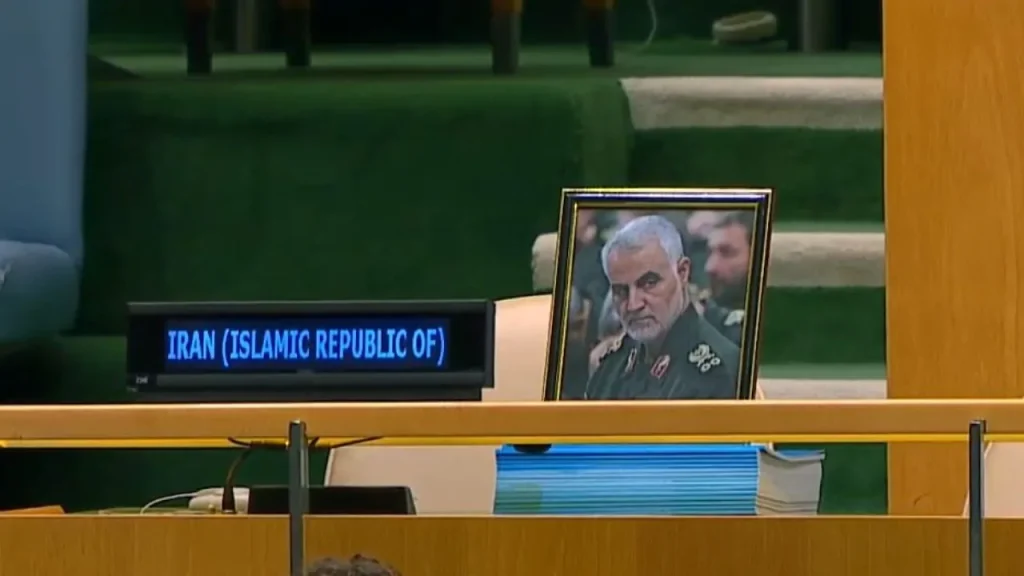
Photographs from the chamber showed Soleimani’s portrait remaining at the Iranian delegation’s position as Netanyahu addressed the Assembly.
The symbolism was unmistakable.
Soleimani played a central role in strengthening Iran’s relationships with resistance movements across Palestine, Lebanon, Iraq and the wider region — precisely the regional network Netanyahu has repeatedly pledged to dismantle.
Iranian media said the portrait had deliberately been left behind as the delegation walked out, presenting it as a message that assassinating resistance commanders had not eliminated the cause or regional strategy associated with them.
The image quickly became one of the most striking scenes of the week: Netanyahu speaking from the UN podium, Iran’s delegation absent in protest, and Soleimani’s portrait still facing the chamber.
The walkout extended well beyond Iran, with dozens of delegations leaving as Netanyahu spoke, reflecting the widening diplomatic isolation facing the occupying regime over Gaza and its continuing wars across the region.
Palestine remains at the centre
Palestine remained one of the central themes running through the General Assembly.
Delegations repeatedly raised the devastation in Gaza, the expansion of settlements in the occupied West Bank and the failure of the international system to restrain the occupying regime.
Ireland again emerged as one of the stronger European voices on Palestine, with Taoiseach Micheál Martin sharply criticising the international response to Gaza and warning over the continuing displacement of Palestinians.
The contrast between Washington’s continuing military and diplomatic support for the occupying regime and growing international criticism was visible throughout the week.
For Tehran, Palestine also remained inseparable from the wider confrontation.
Pezeshkian argued that resistance movements emerge from occupation, foreign intervention and unresolved injustice, and cannot simply be eliminated through military force.
Yemen, Lebanon and the wider Resistance front
The General Assembly was also taking place as conflict continued beyond Iran and Palestine.
Yemen has returned to the centre of the regional confrontation, with Ansarullah engaged in renewed battles and maritime routes through the Red Sea and Bab al-Mandab once again affected by the war.
Lebanon also remains under continuing Israeli attack, while Washington and its allies have intensified pressure over Hezbollah and the wider Resistance axis.
The conflicts are increasingly interconnected: Iran faces direct war with the United States and the occupying regime, Lebanon continues to face Israeli strikes, Yemen remains an active military front, and Gaza remains under occupation and devastation.
Against this backdrop, the General Assembly offered little evidence that the underlying disputes are nearing resolution.
Instead, New York produced a series of images that captured the moment more clearly than the diplomatic language surrounding it: Trump threatening the Islamic Republic from the UN podium; Pezeshkian holding before the world the faces of those killed in Iran; delegates abandoning the hall as Netanyahu spoke; and the portrait of Qassem Soleimani remaining behind at Iran’s empty desk.
For all the diplomacy taking place around the UN, the central struggle across West Asia remains unresolved — over Palestine, occupation, foreign military intervention and whether the region’s future will continue to be determined through American and Israeli military power or by states and movements resisting it.