
The claim that the Holy Prophet Muhammad (peace be upon him and his family) was terrified by his first encounter with revelation and required a Christian scholar to confirm his prophethood has long circulated through prominent Sunni hadith collections. Yet the Qur’an, narrations from the Ahlulbayt and the writings of leading classical and contemporary Shia scholars present a fundamentally different account.
The Holy Prophet Muhammad (s) was entrusted by Allah with the final revelation to humanity. His mission was to proclaim the truth of divine guidance, establish certainty in the hearts of believers and deliver the Holy Qur’an without error or distortion.
Yet one of the most frequently repeated accounts of the beginning of Islam presents an extraordinary contradiction.
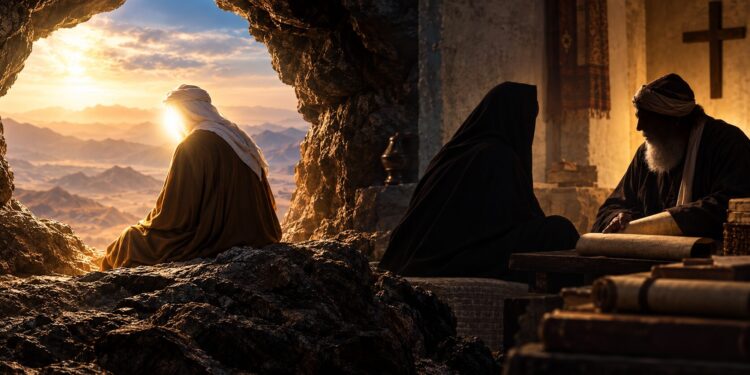
According to narrations preserved in Sahih al-Bukhari and Sahih Muslim, the Messenger of Allah (s) returned from his first encounter with the Angel Jibra’il in the Cave of Hira trembling and afraid. Sayyida Khadija (a) then took him to her relative Waraqa ibn Nawfal, a Christian scholar who identified the experience as divine revelation.
Other versions of the story go further, attributing to the Holy Prophet (s) fears of possession or madness. An additional passage in Sahih al-Bukhari even alleges that he repeatedly contemplated throwing himself from mountain summits during a period when revelation had ceased.
The resulting portrayal is deeply troubling: Allah appoints His final Messenger, sends Jibra’il with revelation, but supposedly leaves the Messenger uncertain about what has happened until a Christian scholar intervenes.
From the standpoint of Shia Islam, this is an unacceptable understanding of prophethood.
The objection is not founded merely upon sentiment or a desire to protect the Holy Prophet’s reputation. It emerges from a substantial body of Qur’anic evidence, narrations transmitted from the Ahlulbayt (a), and the scholarship of generations of Shia theologians, exegetes and historians.
What Do the Sunni Sources Actually Say?
The principal account appears in Sahih al-Bukhari, Kitab Bad’ al-Wahy (The Book of the Beginning of Revelation), Hadith 3, under the chapter concerning how revelation began to the Messenger of Allah (s).
It is transmitted through the following chain:
Yahya ibn Bukayr → al-Layth ibn Sa’d → Uqayl ibn Khalid → Muhammad ibn Shihab al-Zuhri → Urwa ibn al-Zubayr → Aisha.
A closely related narration appears in Sahih Muslim, Kitab al-Iman (The Book of Faith), chapter Bad’ al-Wahy ila Rasul Allah, Hadith 160a. Its chain also converges upon al-Zuhri, Urwa and Aisha.
According to the account, Jibra’il commanded the Holy Prophet Muhammad (s) to recite and seized him three times, pressing him until he was exhausted.
The Holy Prophet (s) then reportedly returned home trembling and asked Sayyida Khadija (a) to cover him.
He is said to have declared:
لقد خشيت على نفسي
“I feared for myself.”
Sayyida Khadija (a) reassured him of his moral excellence before taking him to Waraqa ibn Nawfal, who had embraced Christianity and possessed knowledge of earlier religious scriptures.
After hearing the account, Waraqa reportedly declared:
هذا الناموس الذي أنزل الله على موسى
“This is the Namus whom Allah sent to Musa.”
The significance of the account lies in the apparent transfer of explanatory authority from the Messenger who received revelation to the scholar who interpreted his experience.
Strictly speaking, the principal narration does not explicitly say that the Holy Prophet (s) doubted his appointment until Waraqa certified it. That is an interpretation of the reported sequence. Nevertheless, the narrative’s structure has encouraged precisely that understanding: fear followed by reassurance, consultation and external confirmation.
It is that portrayal which Shia scholarship decisively challenges.
The Question of Transmission
The account is attributed to Aisha, who was not an eyewitness to the first revelation.
Neither al-Bukhari’s nor Muslim’s principal version explicitly identifies the person from whom she learned the details.
Within Sunni hadith methodology, reports of this nature are generally accommodated under the category of mursal al-sahabi. Their acceptance within that methodology is not disputed here.
However, identifying the report’s evidential character remains important.
The principal versions are not independent eyewitness accounts. They converge upon a common transmission through al-Zuhri and Urwa ibn al-Zubayr.
This does not establish fabrication, but it means the appearance of the story in two celebrated collections cannot itself resolve every historical question about its origin, wording or interpretation.
The additional allegations found in other versions must also be examined separately, rather than combined into a single supposedly uniform historical account.
The Qur’an: Revelation Comes With Divine Certainty
The primary authority for understanding revelation is the Holy Qur’an itself.
Allah declares:
نَزَلَ بِهِ الرُّوحُ الْأَمِينُ عَلَىٰ قَلْبِكَ لِتَكُونَ مِنَ الْمُنذِرِينَ
“The Trustworthy Spirit brought it down upon your heart, so that you may be among the warners.” (26:193–194)
The Qur’an also states:
مَا كَذَبَ الْفُؤَادُ مَا رَأَىٰ
“The heart did not deny what it saw.” (53:11)
And concerning the protection of revelation, Allah declares:
فَإِنَّهُ يَسْلُكُ مِن بَيْنِ يَدَيْهِ وَمِنْ خَلْفِهِ رَصَدًا
“He appoints guards before him and behind him.” (72:27)
These passages establish the trustworthiness of the divine communication and the protection surrounding its transmission.
The Holy Prophet Muhammad (s) was not simply someone who experienced an unusual spiritual event and subsequently had to establish whether its source was divine.
He was the Messenger chosen to receive and communicate revelation.
The Qur’an recognises that revelation carries an immense burden. It describes the message as a weighty word (73:5). But the weight of revelation must not be confused with uncertainty concerning its origin.
The Ahlulbayt Directly Address the Problem
The most relevant narration is attributed to Imam Ja’far al-Sadiq (a) and preserved in Tafsir al-Ayyashi, volume 2, page 201, Hadith 106.
Zurara ibn A’yan asks how the Holy Prophet Muhammad (s) knew that what came to him from Allah was not a deception from Satan.
Imam al-Sadiq (a) replies:
إن الله إذا اتخذ عبداً رسولاً أنزل عليه السكينة والوقار
“When Allah appoints a servant as a Messenger, He bestows upon him tranquillity and dignity.”
The Imam continues by explaining that what came to the Messenger from Allah was as clear to him as something he could see with his own eyes.
This narration addresses the central question without ambiguity.
The Messenger’s certainty is bestowed by Allah Himself.
A further narration preserved in the same work, Hadith 105, attributes the Holy Prophet’s recognition of Jibra’il to divine tawfiq, or enabling guidance.
Meanwhile, al-Kafi of Shaykh al-Kulayni, volume 1, Kitab al-Hujjah, chapter on the distinction between a messenger, a prophet and a muhaddath, Hadith 3, records Imam Muhammad al-Baqir (a) explaining that a messenger encounters Jibra’il directly and receives communication from him.
The Imam specifically describes the Holy Prophet Muhammad (s) as receiving the angel face to face when his prophethood and mission were united.
This report is transmitted through Muhammad ibn Yahya, Ahmad ibn Muhammad, al-Hasan ibn Mahbub and al-Ahwal, and has been graded authentic by later Shia hadith authorities, including Allama Muhammad Baqir al-Majlisi.
These narrations describe revelation as a direct, divinely enabled encounter, not an ambiguous experience dependent upon the judgement of Waraqa.
The report in Tafsir al-Ayyashi has a transmission limitation because its surviving recension omits full chains. This should be acknowledged rather than concealed. Its significance rests upon its explicit theological content and consistency with the broader Qur’anic account and other Shia reports.
Classical Shia Scholarship: The Foundations of the Rejection
The Shia rejection of prophetic uncertainty did not originate with contemporary debates over Sunni hadith.
Its foundations were established by early scholars who examined the knowledge, infallibility and divine preparation required of Allah’s messengers.
Their discussions provide the doctrinal criteria against which the Waraqa narrative must be assessed.
Shaykh al-Kulayni: Revelation as a Direct Encounter
Shaykh Muhammad ibn Ya’qub al-Kulayni (d. 329 AH) preserves in al-Kafi the aforementioned narration from Imam al-Baqir (a), distinguishing the different forms of divine communication.
The report presents Jibra’il as communicating directly with the Holy Prophet Muhammad (s), who had already experienced signs associated with prophethood before the commencement of his mission.
This is significant because the Messenger’s preparation precedes the public revelation.
The Holy Prophet (s) is not depicted as an unprepared individual suddenly confronted by an inexplicable phenomenon.
Shaykh al-Saduq: Prophets Cannot Be Characterised by Ignorance
Shaykh Muhammad ibn Ali al-Saduq (d. 381 AH), in al-I’tiqadat fi Din al-Imamiyyah, page 96, states that prophets and messengers are protected and characterised by perfection, completeness and knowledge.
He writes:
موصوفون بالكمال والتمام والعلم من أوائل أمورهم إلى أواخرها
“They are characterised by perfection, completeness and knowledge from the beginning of their affairs to their end.”
He further rejects attributing ignorance or deficiency to them.
Although this statement is not a specific commentary upon Waraqa ibn Nawfal, it establishes a fundamental theological objection to the suggestion that the Holy Prophet Muhammad (s) lacked the knowledge required to recognise his own divine appointment.
Shaykh al-Mufid: Revelation Cannot Rest on Unverified Reports
Shaykh Muhammad ibn Muhammad al-Mufid (d. 413 AH) develops the early Imamiyyah approach in Tashih I’tiqadat al-Imamiyyah.
Discussing revelation and transmitted accounts, Shaykh al-Mufid distinguishes between matters established by decisive evidence and reports which cannot be affirmed with certainty.
He refuses to treat a solitary report as conclusive merely because it has been transmitted, particularly where neither the Qur’an nor a decisive proof establishes its contents.
In his discussion of revelation, he acknowledges that Allah communicates with His Messenger through different means, including angelic mediation.
His methodology is especially relevant to the Waraqa story: transmitted accounts require scrutiny, and speculative historical detail cannot be elevated above established theological principles.
This is not evidence that Shaykh al-Mufid explicitly discussed the Waraqa narration. It is evidence of the critical method through which such narrations should be evaluated.
Shaykh al-Tusi: The Reliability of the Messenger Is Essential
Shaykh Muhammad ibn al-Hasan al-Tusi (d. 460 AH), in al-Iqtisad fima Yata’allaq bil-I’tiqad, examines the necessity of prophetic infallibility.
He explains that a prophet must be protected from conduct that would undermine confidence in his testimony and the divine message.
The purpose of prophethood requires the Messenger to be a reliable authority through whom humanity receives guidance.
The application to the Waraqa narrative is clear.
If the Messenger himself cannot establish that the revelation he receives is genuinely divine, the reliability of the message becomes dependent upon a subsequent human interpretation.
That possibility is incompatible with the theological foundations articulated by Shaykh al-Tusi.
Allama al-Majlisi: The Messenger Was Divinely Prepared Before the Revelation
Allama Muhammad Baqir al-Majlisi (d. 1111 AH) offers a particularly substantial account in Bihar al-Anwar, volume 18, page 279.
Having considered the transmitted reports, he concludes that the Holy Prophet Muhammad (s) was already supported by the Holy Spirit before the commencement of his public mission.
Allama al-Majlisi describes the Holy Prophet (s) as receiving angelic communication and experiencing true visions before the age of forty, after which he received the public commission to convey the Qur’an.
His position presents the beginning of revelation as the culmination of divine preparation rather than an experience of fundamental uncertainty.
This represents a substantive alternative to the notion that the Holy Prophet (s) needed Waraqa to understand what had happened.
Contemporary Shia Scholarship: Direct Refutations of the Waraqa Narrative
While classical Shia scholarship established the underlying principles, several contemporary scholars have investigated the Waraqa story itself and explicitly challenged its credibility.
Their critiques extend beyond general theology to the wording, transmission, internal contradictions and implications of the historical reports.
Grand Ayatollah Nasir Makarim Shirazi: The Narration Is Fabricated
Among the clearest refutations is that of Grand Ayatollah Shaykh Nasir Makarim Shirazi in Nafahat al-Qur’an, volume 1, pages 183–184.
After explaining that prophets recognise divine revelation from the moment they receive it, he directly addresses the narration describing the Holy Prophet Muhammad (s) returning from Hira frightened and being taken to Waraqa.
Grand Ayatollah Makarim Shirazi states:
وكون هذا الحديث مختلق أمر لا ريب ولا شك فيه
“That this narration is fabricated is a matter about which there is no doubt.”
He questions how the Messenger, who possessed direct access to divine revelation, could require a Christian scholar to establish the nature of his experience.
He also draws a comparison with Prophet Musa (a), whose reception of divine communication at Mount Sinai did not depend upon another person establishing whether Allah had addressed him.
For Grand Ayatollah Makarim Shirazi, the story’s depiction of prophetic uncertainty contradicts the nature of revelation and cannot be accepted as an authentic account.
Allama al-Tabataba’i: A Prophet Does Not Doubt the Source of Revelation
In al-Mizan fi Tafsir al-Qur’an, volume 14, page 138, Allama Sayyid Muhammad Husayn al-Tabataba’i discusses the certainty accompanying divine revelation.
Commenting on Prophet Musa’s (a) encounter with Allah, he explains that when a prophet first receives revelation, no doubt arises concerning its divine source.
He states:
لم يختلجه شك ولم يعتره ريب في أن الذي يوحي إليه هو الله سبحانه
“No doubt enters him, nor does uncertainty arise that the One revealing to him is Allah.”
He further explains that this certainty does not depend upon a subsequent intellectual investigation or the search for external proofs.
Although the passage is not itself an examination of the Waraqa report, Allama al-Tabataba’i establishes the general principle which Grand Ayatollah Makarim Shirazi subsequently applies to that story.
The Messenger recognises revelation through the nature of the divine communication itself.
Allama Sayyid Murtada al-Askari: Waraqa Becomes More Knowledgeable Than the Prophet
Allama Sayyid Murtada al-Askari directly criticises the account in Ma’alim al-Madrasatayn, volume 1, in his discussion of conflicting portrayals of the Messenger of Allah (s).
After citing the report transmitted by al-Bukhari and Muslim, Allama al-Askari points to its extraordinary implication.
Waraqa, the Christian scholar, appears more knowledgeable about Jibra’il and revelation than the Holy Prophet Muhammad (s), who had directly received the message.
The difficulty is unmistakable.
The Messenger receives revelation, yet the scholar apparently explains its identity. The Messenger witnesses the angel, yet Waraqa possesses the explanatory certainty.
Allama al-Askari treats this as part of a wider problem involving narrations that attribute deficiencies to the Holy Prophet (s) contrary to the Qur’anic understanding of his station.
His criticism highlights how the portrayal of prophetic uncertainty risks elevating the authority of an ordinary human observer above the divinely appointed Messenger.
Allama Sayyid Ja’far Murtada al-Amili: The Historical Accounts Contradict One Another
Allama Sayyid Ja’far Murtada al-Amili devotes a detailed discussion to the beginning-of-revelation reports in al-Sahih min Sirat al-Nabi al-A’zam, volume 3, chapter entitled Riwayat Bad’ al-Wahy.
His approach is particularly valuable because he examines the historical material before presenting his theological conclusions.
He compares versions in which Sayyida Khadija (a) accompanies the Holy Prophet Muhammad (s) to Waraqa with other reports describing different sequences of consultation and additional individuals supposedly identifying the angel.
He also questions the repeated physical pressing attributed to Jibra’il and the portrayal of the Holy Prophet (s) as overwhelmed by an experience he could not understand.
Allama al-Amili describes the reports as conflicting and internally problematic.
In his discussion of the sounder account, he argues that the Holy Prophet (s) received revelation in Hira and returned to his family conscious of the honour Allah had bestowed upon him and reassured concerning the responsibility entrusted to him.
He cites the narration from Imam al-Sadiq (a) concerning divine tranquillity as evidence for this understanding.
For Allama al-Amili, the disputed narrative cannot be defended merely because of its appearance in established historical collections.
Ayatollah Muhammad Hadi Ma’rifat: Revelation Cannot Be Confused With Deception
Ayatollah Muhammad Hadi Ma’rifat examines the Waraqa narrative in al-Tamhid fi Ulum al-Qur’an, volume 1, under the sections Qissat Waraqa ibn Nawfal and al-Wahy la Yahtamil Iltibasan.
His analysis approaches the matter from the sciences of the Qur’an.
Ayatollah Ma’rifat explains that prophetic revelation is accompanied by certainty concerning its origin. It is not an uncertain impression that must be subjected to the judgement of another individual before the Messenger can recognise it.
He draws upon the Qur’an, the reports attributed to Imam al-Sadiq (a), and the special spiritual preparedness of the Holy Prophet Muhammad (s).
The implication of his analysis is that a story which makes Waraqa’s interpretation necessary for establishing the divine nature of revelation is inconsistent with the very definition of prophetic communication.
Ayatollah Muhammad al-Sanad: The Fiction Is in the Story, Not Necessarily Waraqa’s Existence
Ayatollah Shaykh Muhammad al-Sanad provides another explicit rejection in a published response concerning whether Waraqa ibn Nawfal was a real historical figure.
He states:
الخيال المنسوج ليس في شخصية ورقة بن نوفل بل في القصة التي يرويها العامة
“The invented fiction is not in the person of Waraqa ibn Nawfal, but in the story narrated about him.”
Ayatollah al-Sanad then specifically rejects the account of the Holy Prophet Muhammad (s) turning to Waraqa to confirm his prophethood and supposedly doubting revelation.
This distinction is essential.
The Shia objection does not require the denial of Waraqa’s historical existence.
Waraqa may have been a knowledgeable religious figure who recognised signs of the coming Messenger. What is rejected is the suggestion that his judgement was needed to establish the Holy Prophet’s certainty about his own divine mission.
Allama Sayyid Hashim al-Musawi: A Textual Comparison With the Ahlulbayt
Allama Sayyid Hashim al-Musawi provides a focused treatment in al-Qur’an fi Madrasat Ahlulbayt, pages 25–35, under the title Bad’ al-Wahy wa Shubhat Waraqa ibn Nawfal.
He compares the contested beginning-of-revelation narratives with the Qur’anic account and narrations transmitted from the Imams of Ahlulbayt (a).
Particular attention is given to the report from Imam al-Sadiq (a), the divine preparation described by Imam Ali (a), and the claim that the Holy Prophet (s) needed another person’s judgement to establish the source of revelation.
The significance of his contribution is methodological. Rather than relying on the apparent absurdity of the disputed portrayal alone, he examines the competing transmitted accounts and the doctrines which emerge from them.
The More Extreme Allegation: Did the Prophet Contemplate Self-Destruction?
An additional passage in Sahih al-Bukhari, Kitab al-Ta’bir (The Book of Interpretation of Dreams), Hadith 6982, contains a particularly disturbing allegation.
It claims that during a period in which revelation ceased, the Holy Prophet Muhammad (s) repeatedly contemplated throwing himself from mountain summits, only to be reassured by Jibra’il that he was indeed Allah’s Messenger.
However, the Arabic text contains an important qualification:
فيما بلغنا
“According to what has reached us.”
This passage is associated with al-Zuhri’s transmitted material and is not an uninterrupted eyewitness report from Aisha.
It would therefore be inaccurate to assign the allegation the same connected transmission status as the principal report.
The distinction is decisive from a hadith-critical perspective.
An allegation of this seriousness cannot become an established historical fact merely through its inclusion in a major compilation.
The additional report also raises a further theological difficulty: it portrays the Holy Prophet (s) as repeatedly requiring confirmation of his prophetic identity.
Such a claim is inconsistent with the understanding of revelation presented in the Qur’an and the teachings attributed to the Ahlulbayt (a).
The Rational Argument: How Can a Messenger Need Another Man to Authenticate Revelation?
Having examined the textual evidence, the underlying rational contradiction becomes clear.
If the Holy Prophet Muhammad (s) required Waraqa to determine whether his encounter was divine, then the Messenger’s knowledge of revelation would have depended upon someone who had not received it.
This would create an unacceptable reversal of religious authority.
The person entrusted with the revelation would be uncertain of its source, while the person who merely heard a description of it would supposedly possess the necessary certainty.
Moreover, if the Holy Prophet (s) could not reliably distinguish revelation from another experience, the foundation of certainty in the Qur’an would itself be called into question.
The entire purpose of prophethood requires that Allah’s Messenger reliably receive and convey the divine message.
This rational argument does not deny that prophets experience fear, grief, exhaustion or hardship. The Qur’an itself documents such experiences.
Rather, it distinguishes ordinary human emotions from uncertainty about divine appointment.
The Holy Prophet Muhammad (s) could experience the tremendous weight of revelation without doubting that it came from Allah.
These are fundamentally different matters.
Conclusion: The Messenger Did Not Need Waraqa to Recognise His Lord
The Waraqa ibn Nawfal narrative must be subjected to the same critical examination as any other historical report.
The principal account in al-Bukhari and Muslim is not an eyewitness testimony from Aisha. Its transmission must be distinguished from the additional allegations introduced in other versions, and its precise wording must not be confused with subsequent interpretations.
More importantly, the Qur’an presents revelation as divinely safeguarded, while the narrations of the Ahlulbayt (a) explicitly affirm the certainty bestowed upon Allah’s messengers.
The classical Shia scholars established the theological foundations of prophetic knowledge, infallibility and the reliability of revelation.
Contemporary scholars, including Grand Ayatollah Makarim Shirazi, Allama al-Askari, Allama al-Amili, Ayatollah Ma’rifat and Ayatollah al-Sanad, have gone further by directly challenging the disputed story itself.
Their collective arguments expose the central weakness in the portrayal: the Holy Prophet Muhammad (s), chosen by Allah to guide humanity, cannot be reduced to an individual whose knowledge of his divine appointment depended upon the judgement of a Christian scholar.
Waraqa may have recognised the signs of prophethood. Sayyida Khadija (a) undoubtedly supported the Messenger with unparalleled loyalty and sacrifice.
Neither proposition requires accepting that the Holy Prophet (s) lacked certainty about revelation.
Waraqa may have recognised the Messenger of Allah, but the Messenger of Allah did not need Waraqa to recognise his Lord.
References and Sources
Primary Sunni reports
- Imam al-Bukhari, Sahih al-Bukhari, Kitab Bad’ al-Wahy, Hadith 3 — Original text.
- Imam Muslim, Sahih Muslim, Kitab al-Iman, chapter on the beginning of revelation, Hadith 160a — Original text.
- Imam al-Bukhari, Sahih al-Bukhari, Kitab al-Ta’bir, Hadith 6982 — Original text.
Shia narrations and classical scholarship
- Shaykh al-Ayyashi, Tafsir al-Ayyashi, vol. 2, p. 201, Hadiths 105–106 — Text.
- Shaykh al-Kulayni, al-Kafi, vol. 1, Kitab al-Hujjah, Bab al-Farq bayn al-Rasul wa al-Nabi wa al-Muhaddath, Hadith 3 — Text and hadith gradings.
- Shaykh al-Saduq, al-I’tiqadat fi Din al-Imamiyyah, chapter on infallibility, p. 96.
- Shaykh al-Mufid, Tashih I’tiqadat al-Imamiyyah, section on revelation, p. 122 — Text.
- Shaykh al-Tusi, al-Iqtisad fima Yata’allaq bil-I’tiqad, discussion of prophetic infallibility.
- Allama al-Majlisi, Bihar al-Anwar, vol. 18, pp. 278–283, discussion of the Holy Prophet’s status before the public mission — Text.
Contemporary Shia scholarship
- Grand Ayatollah Nasir Makarim Shirazi, Nafahat al-Qur’an, vol. 1, pp. 183–184 — Text.
- Allama Sayyid Muhammad Husayn al-Tabataba’i, al-Mizan fi Tafsir al-Qur’an, vol. 14, p. 138.
- Allama Sayyid Murtada al-Askari, Ma’alim al-Madrasatayn, vol. 1, section on the differing portrayals of the Messenger of Allah (s) — Text.
- Allama Sayyid Ja’far Murtada al-Amili, al-Sahih min Sirat al-Nabi al-A’zam, vol. 3, chapter Riwayat Bad’ al-Wahy, pp. 7–35 — Text.
- Ayatollah Muhammad Hadi Ma’rifat, al-Tamhid fi Ulum al-Qur’an, vol. 1, sections Qissat Waraqa ibn Nawfal and al-Wahy la Yahtamil Iltibasan, pp. 113–118 in the Mu’assasat al-Tamhid edition.
- Grand Ayatollah Muhammad al-Sanad, response entitled Waraqa ibn Nawfal: Hal Huwa Shakhsiyyah Haqiqiyyah am Khayaliyyah? — Published response.
- Allama Sayyid Hashim al-Musawi, al-Qur’an fi Madrasat Ahlulbayt, pp. 25–35, Bad’ al-Wahy wa Shubhat Waraqa ibn Nawfal — Text.
Page numbers vary between editions. The classical scholars cited for their general theology of prophethood should be distinguished from contemporary scholars whose published works explicitly criticise the Waraqa account.