
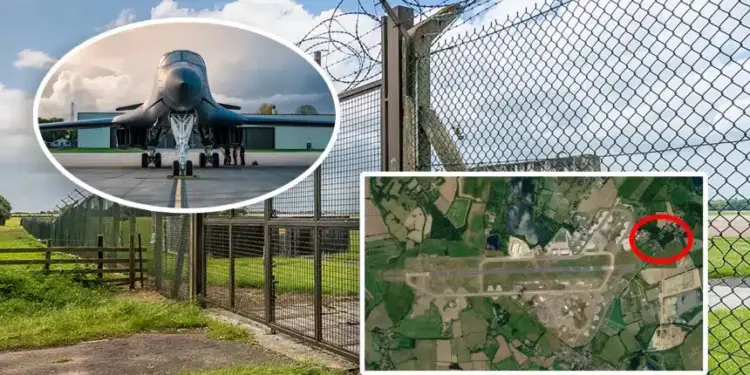
A British counter-terrorism investigation into a suspected incident near RAF Fairford has expanded to six arrests, but the case is also drawing attention to the base’s long history as a launchpad for US military operations against Iraq and Iran — and to Washington’s rapid attempts to frame the affair as the work of a foreign actor.
Five British men aged between 23 and 25 were arrested near RAF Fairford in Gloucestershire in the early hours of Sunday, 27 September, after three suspicious vehicles were reported close to the base.
They were initially detained under the Explosives Act and later on suspicion of preparing terrorist acts.
The operation led to evacuations and a large police response, but investigators later confirmed that no improvised explosive devices were found. Petrol was recovered from the vehicles, and all five men were subsequently released on strict bail while inquiries continued.
A sixth suspect, a dual British-Iranian national, was arrested in London on 1 October.
No one has yet been charged.
Washington shaped the narrative early
Before British investigators had publicly established foreign-state responsibility, senior figures in Washington were already presenting the incident in geopolitical terms.
US President Donald Trump said those involved had intended to cause “big damage” to what he called “our fort”, referring to RAF Fairford.
US Secretary of State Marco Rubio then went further, saying the incident “clearly” involved the “hands of a foreign actor”.
At that point, British police were still saying they were examining several possibilities, including whether individuals had acted knowingly or unknowingly on behalf of another country.
The British government subsequently said there were “strong indications” of possible Iranian involvement, but investigators have not publicly disclosed evidence demonstrating that Tehran directed the alleged operation. Iran has categorically denied involvement.
The chronology matters: Washington was publicly asserting foreign involvement before British authorities had reached the same public position.
Fairford and America’s wars
The importance of RAF Fairford goes far beyond the present investigation.
Although it carries an RAF name and stands on British soil, Fairford has for decades been a major hub for American strategic air power.
US B-52 bombers operated from the base during the 1991 Gulf War and again during the 2003 invasion of Iraq.
In the years since, Fairford has hosted American strategic bombers and U-2 reconnaissance aircraft, while its role has again grown during the confrontation with Iran.
This history is essential to understanding why Fairford has repeatedly attracted opposition.
Ahead of the 2003 invasion of Iraq, anti-war activists carried out direct actions at the base aimed at stopping American B-52s from participating in the bombing campaign.
Some later argued before British courts that they had acted in an attempt to prevent greater crimes against Iraqi civilians.
A question of sovereignty
The Fairford controversy also exposes a wider reality about Britain’s relationship with the United States.
The base may carry the letters “RAF”, but its strategic importance lies overwhelmingly in the American aircraft, personnel and military missions operating from it.
The history of Fairford has therefore raised longstanding questions over how much meaningful sovereignty Britain exercises when its territory is used to project US military power across West Asia.
Trump’s description of the facility as “our fort” was striking precisely because it appeared to say openly what is often obscured by official terminology.
The contradiction is clear: a British-labelled facility has for decades been deeply integrated into Washington’s military operations.
Allegations are not evidence
Iran has obvious reasons to view RAF Fairford as strategically significant. The base has been used by a military currently conducting operations against Iran.
That makes an Iranian connection a legitimate line of investigation.
But it does not establish one.
What is currently known is that five British men were stopped near the base, petrol was recovered but no explosive devices were found, a sixth British-Iranian man was later arrested, and police are examining possible foreign-state involvement.
What has not been publicly established is what attack was allegedly planned, how the petrol was intended to be used, whether the suspects could have inflicted the damage described by Trump, or whether Tehran directed them.
Those distinctions are particularly important when the accusations are being made by the same US administration whose military has used RAF Fairford as part of its operations against Iran.
The investigation may ultimately provide evidence of foreign involvement.
Until then, the Fairford case should be understood not only as a counter-terrorism investigation, but as a story about American military power operating from Britain, the war against Iran, and the speed with which allegations can become a geopolitical narrative before the evidence has been made public.