
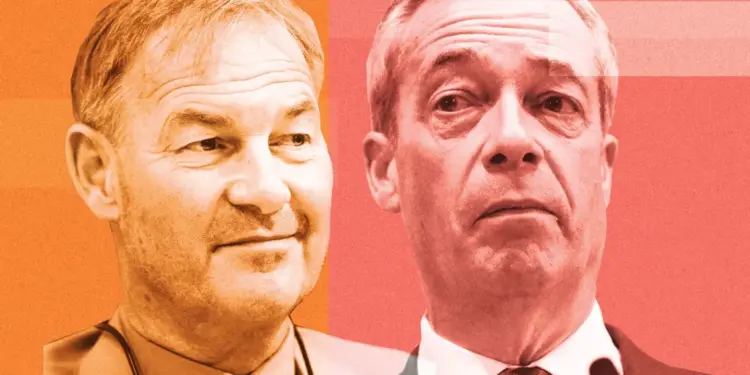
A potential political pact between Nigel Farage’s Reform UK and Rupert Lowe’s Restore Britain has raised fresh concerns over the growing normalisation of anti-Muslim politics in Britain, after Lowe made opposition to what he calls the “Islamification of Britain” a central condition for cooperation.
The possibility of an alliance emerged after Restore Britain leader Rupert Lowe publicly urged Nigel Farage to put aside their bitter personal dispute and explore cooperation between the two parties ahead of the next general election.
Farage subsequently confirmed that he had contacted Lowe and said he was approaching the proposal with an “open mind”, while arguing that a divided right could damage Reform UK electorally.
The discussions are significant because Restore Britain is not merely calling for tighter immigration controls. Lowe has explicitly placed Islam and the public presence of Muslims at the centre of his political programme.
In outlining his conditions for cooperation with Reform, Lowe pledged to reverse what he described as the “Islamification of Britain”, claiming that the influence of Islam on Britain’s “Christian way of life” had become unacceptable.
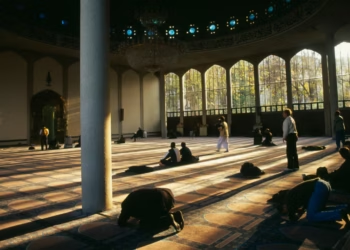
His proposals include bans on halal slaughter, the burqa, Sharia councils and what he describes as “mass-dominating public Islamic prayer”, alongside restrictions on cousin marriage. He has also called for mass deportations, including the removal of undocumented migrants “including women and children”.
Such proposals go well beyond the conventional debate over immigration and would place specifically Muslim religious practices under state restriction.
For Britain’s Muslim population, the political development is therefore about more than two right-wing parties attempting to avoid splitting their vote. It raises the prospect of openly anti-Islam policies becoming part of the negotiating currency of mainstream electoral politics.
Reform moves further right
Reform itself has already adopted an increasingly confrontational approach towards migration and Islam.
Its home affairs spokesman Zia Yusuf has previously said that a Reform government would seek to confront “radical Islam”, withdraw Britain from the European Convention on Human Rights and carry out large-scale deportations.
This week, Reform went further on immigration by announcing “Operation Fortress”, a proposal to use military assets in the English Channel to intercept small boats and return those onboard to France.
Farage claimed that under a Reform government “within a fortnight, there would be no more boats”, although legal and military experts have questioned whether such a policy could actually be implemented without French cooperation.
Against this backdrop, an understanding with Restore Britain could push Reform further towards policies built around cultural and religious exclusion rather than immigration alone.
Lowe appears to understand his leverage. Restore Britain remains considerably smaller than Reform, but under Britain’s first-past-the-post electoral system even a relatively small number of votes could determine the outcome of closely contested constituencies.
The party recently won 8.7% in the Greater Manchester mayoral by-election, while Reform secured 21%.
A Restore candidate taking several percentage points from Reform across marginal seats could therefore cost Farage’s party parliamentary representation.
That gives Lowe an incentive to demand ideological concessions in exchange for electoral cooperation.
From rivalry to cooperation
Relations between Farage and Lowe have been intensely hostile.
Lowe entered Parliament as a Reform MP in 2024 but was suspended from the party in March 2025 following allegations concerning his treatment of staff and threats against then-party chairman Zia Yusuf, allegations Lowe denied. He later founded Restore Britain.
Only weeks ago, Lowe accused Farage of attempting to “politically assassinate” him.
Yet electoral arithmetic appears to be encouraging reconciliation.
Lowe now says their personal disagreements should be put aside, while Farage has acknowledged that Restore candidates could inflict serious electoral damage on Reform.
The result could be a division of labour on the British right: Reform presenting itself as the more electorally acceptable vehicle while Restore pulls the political conversation further towards explicit anti-Muslim policies.
British Muslims increasingly in the political crosshairs
The wider concern is the speed with which rhetoric once associated with Britain’s political fringes is becoming part of national political discussion.
Muslim religious practice, mosques, halal food, Islamic dress and public prayer are increasingly being portrayed not simply as issues for debate but as threats to British national identity.
Restore Britain’s programme makes that framing explicit.
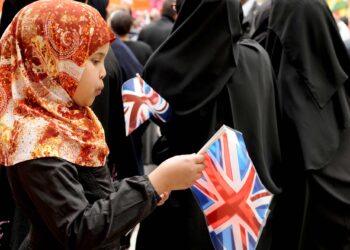
Its language transforms millions of British Muslims — many born and raised in Britain — into a demographic and cultural problem to be reversed.
If Reform ultimately accepts even part of Lowe’s platform in pursuit of electoral unity, the consequences would extend beyond immigration policy. It would represent another step towards institutionalising suspicion of Islam itself within British politics.
No formal Reform–Restore pact has yet been agreed, and significant personal and political differences remain between Farage and Lowe.
But the fact that such discussions are now taking place is itself significant.
For British Muslims, the question is no longer simply whether anti-Muslim rhetoric exists on the political margins.
It is whether hostility towards Islam is becoming a viable route to national political power.