
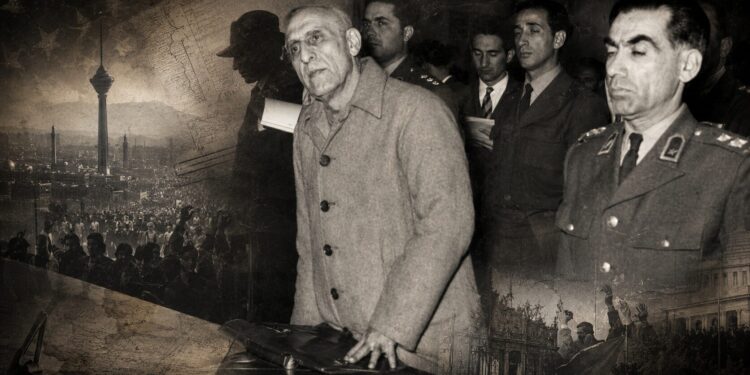
Every year on 28 Mordad of the Iranian calendar, Iran remembers one of the most consequential events in its modern history: the overthrow of Prime Minister Mohammad Mosaddegh in the US-British-backed coup of 19 August 1953.
Seventy-three years later, the anniversary continues to be revisited across Iran through television programmes, documentaries, newspaper features, political speeches and discussions of the country’s relationship with Western powers. On 28 Mordad this year — 19 August 2026 — Iranian media again returned to the coup, with Press TV broadcasting a new documentary, Operation Ajax 1953, drawing on lesser-seen documents concerning the foreign intervention. Iran’s embassy in London also marked the anniversary by connecting the events of 1953 with subsequent Western policies towards the country.
This form of remembrance is not confined to official political statements. In 2025, for example, a documentary about Dr Hossein Fatemi, Mosaddegh’s foreign minister who was later executed by the Shah’s government, received its public premiere in Tehran deliberately on the anniversary of 28 Mordad, attended by filmmakers, cultural figures and political personalities.
Rather than being remembered simply as an old dispute over who governed Iran seven decades ago, 28 Mordad has become part of the country’s political memory: a reference point in debates about foreign interference, national sovereignty and whether powerful states can be trusted when their strategic interests clash with those of Iran.
Among those who repeatedly returned to the lessons of the coup was Ayatollah Sayyid Ali Khamenei, who regarded Mosaddegh’s experience as one of the clearest historical examples of the danger of confusing diplomatic engagement with strategic reliance on a foreign power.
What happened on 28 Mordad?
Mohammad Mosaddegh became prime minister amid a powerful national movement demanding Iranian control over the country’s oil resources.
For decades, Britain had exercised enormous influence over Iranian oil through the Anglo-Iranian Oil Company. Mosaddegh became closely identified with the nationalisation of the oil industry, placing him on a collision course with London.
Britain responded with intense political and economic pressure and eventually sought American assistance in removing him. Declassified documents show that British officials approached the Truman administration in 1952 with proposals for a coup. Washington initially resisted, but US policy changed after Dwight Eisenhower entered the White House.
The subsequent covert operation, known to the CIA as TPAJAX or Operation Ajax, was planned and implemented during 1953. The US State Department’s own published historical archive contains extensive documentation covering the planning and implementation of the operation between March and August of that year.
The eventual overthrow involved American and British intelligence alongside Iranian royalists, military officers and other domestic actors. Mosaddegh was removed, General Fazlollah Zahedi became prime minister and Mohammad Reza Pahlavi returned to Iran, with the Shah subsequently consolidating his power.
The foreign role in the coup is therefore not merely a claim made by the Islamic Republic. It is established in declassified Western records.
But for Ayatollah Khamenei, the most important question was what political lesson Iran should draw from it.
Mosaddegh’s great mistake was trusting America
Ayatollah Khamenei repeatedly argued that the belief that American hostility could necessarily be overcome through concessions or reliance on Washington was contradicted by Iran’s own modern history.
For Ayatollah Khamenei, Mosaddegh was particularly important because he was not an Islamic revolutionary and was not fundamentally anti-American. He was primarily confronting British domination and believed that the United States might assist him.
Ayatollah Khamenei said:
“There are some people who say: perhaps if we somehow come to terms with America a little, their hostility towards us will decrease. No. They did not even show mercy to those who trusted America, placed their hopes in America, and went to America seeking help. Who, for example? Dr Mosaddegh.
“Dr Mosaddegh, in order to be able to struggle against the British and stand against Britain, imagined that he should turn to the Americans. He met with them, negotiated with them and made requests of them; he trusted them.
“The coup of 28 Mordad was carried out in Iran not by Britain, but by America, against Mosaddegh.
“In other words, they are not even satisfied with people such as Mosaddegh. They want servants; they want those who are completely subservient; they want people who allow themselves to be humiliated. Like whom? Like Mohammad Reza Pahlavi.
“That is the kind of person they want to rule over this abundant, blessed and wealthy country — a country which is sensitive because of its geographical position and sensitive because of its various capabilities. They want someone who stands before them with his hands tied, completely surrendered to them. This is what the Americans want. If they cannot have that, they become enemies.”
— Meeting with school and university students, 2 November 2017
Ayatollah Khamenei’s emphasis here was on the decisive operational role eventually played by the United States. Historically, however, Britain was also deeply involved: London had initially pushed Washington towards regime change, while the CIA subsequently became central to implementing the operation.
The wider point in Ayatollah Khamenei’s argument was that Mosaddegh had not sought confrontation with Washington. He had hoped to use American power to counterbalance Britain.
The state he hoped would protect Iranian independence instead participated in destroying his government.
“Those who today incline towards the West have lost their reason”
For Ayatollah Khamenei, 28 Mordad was therefore not simply an ideological argument about whether one liked or disliked America.
He framed it as a question of learning from historical experience.
Political judgement, he argued, requires nations to remember what previous encounters with major powers actually produced.
Ayatollah Khamenei said:
“Those who today support an inclination towards the West have, in my opinion, lost their reason; they are not thinking rationally.
“Those who say that, for the country to progress, we must rely on the West, seek refuge in the West and strengthen our friendship with them are, in my opinion, not speaking rationally.
“Well, the West has given us experiences. The first thing reason does is make use of experience.
“Reza Khan was imposed upon us by the Westerners: twenty years of that extraordinary and unparalleled despotism and dictatorship.
“Then the Westerners imposed Mohammad Reza Shah upon this country. The people had no role in it. The Westerners sat together and decided that he should take his father’s place.
“Then the Westerners helped him so that he could overthrow a national government.
“The Westerners themselves directly overthrew Mosaddegh’s government on 28 Mordad — and Mosaddegh’s government was a national government. I have nothing to do here with Mosaddegh’s beliefs; ultimately, it was a national government.”
— Meeting with a group of university students, 2 July 2016
Here, 28 Mordad is placed within a much longer historical narrative.
In Ayatollah Khamenei’s reading, Iran’s experience of Western intervention did not begin with disagreements between the Islamic Republic and the United States after 1979. It stretched back through the Pahlavi period and before it.
That distinction matters because it challenges the idea that tensions between Iran and Western powers can be explained solely by the ideology of the Islamic Republic.
“Whenever officials trusted America, they were struck”
Ayatollah Khamenei also frequently invoked Mosaddegh when discussing negotiations with Washington.
His argument was not that negotiations themselves could never occur. Rather, he warned against treating American assurances as a substitute for independent Iranian power and political judgement.
In 2013, Ayatollah Khamenei said:
“Negotiation with America does not solve the problem. Where have they fulfilled their promises?
“For sixty years, from 28 Mordad 1332 until today, in every instance in which the officials of this country trusted the Americans, they were struck.
“At one point Mosaddegh trusted the Americans, relied upon them and regarded them as his friends. Then the events of 28 Mordad took place.
“The headquarters of the coup were placed at the disposal of the Americans, and the agent of the coup came to Tehran with a suitcase full of money and distributed money among thugs and hooligans in order to launch the coup. He was an American.
“They themselves have admitted and acknowledged that they planned the operation.
“Afterwards, they imposed the oppressive Pahlavi regime upon this country for many years. They established SAVAK, placed the fighters in chains and tortured them. That belongs to that period.”
— Meeting with commanders and personnel of the Islamic Republic of Iran Air Force, 7 February 2013
The significance of 28 Mordad, in this analysis, therefore extends beyond the immediate removal of Mosaddegh.
The coup was followed by the strengthening of Mohammad Reza Shah, whose government became one of Washington’s closest allies in West Asia.
For Ayatollah Khamenei, the historical sequence was cumulative: Mosaddegh looked towards America for assistance; America participated in his overthrow; and the political order that followed became closely dependent upon Western support.
America’s problem is with an independent Iran
Perhaps the most fundamental conclusion Ayatollah Khamenei drew from Mosaddegh’s overthrow was that conflict with major Western powers was not ultimately restricted to the Islamic character of the post-1979 Iranian state.
He argued that the deeper issue was whether Iran could make major political decisions independently.
Ayatollah Khamenei said:
“Many of our problems with America are fundamentally incapable of being resolved. The reason is that America’s problem with us is us ourselves — meaning the Islamic Republic itself. This is the problem.
“The problem is not nuclear energy; the problem is not human rights. America’s problem is with the very existence of the Islamic Republic.
“For a government, a system and a political order to emerge — especially in an important place such as Iran, and especially in a wealthy land such as Iran — and for a government to come to power which does not pay attention to the ‘yes’ and ‘no’ of a power such as America, but itself says ‘yes’ and ‘no’ regarding its own affairs: this is intolerable for them.
“They oppose this. They confront this. How do you intend to resolve such a confrontation?
“Therefore, our problems with America cannot be resolved in this manner. They have a problem with the very basis of the system.
“Let me tell you this: even putting the Islamic Republic aside, they also have a problem with the independence of the country.
“Suppose a system other than the Islamic Republic were in power, but it intended to be independent; they would have a problem with that too.
“The experience of the National Movement is before our eyes. During the National Movement, Dr Mosaddegh had a favourable opinion of the Americans — indeed, he had an attachment to them — but he did not wish to become dependent upon them. He was, of course, opposed to the British, and he desired independence.
“The person who became the agent of the coup against Dr Mosaddegh was not a British man, but an American, and behind him — even more than the British Intelligence Service — stood America’s CIA.
“This is what America is like.
“In other words, they could not even tolerate a system and a government that was in no sense a religious government and was not even a revolutionary government. The National Movement was not a revolutionary government. It was simply seeking the country’s independence from beneath the yoke of the British and imagined that the Americans would help it.
“They could not tolerate it. They are opposed to the independence of the country.”
— Meeting with officials of the Islamic Republic, 12 June 2017
This is perhaps the key to understanding why Ayatollah Khamenei returned to Mosaddegh so often.
If the conflict were purely about Islam, the Islamic Revolution or Iran’s nuclear programme, then Mosaddegh should not have faced the same problem.
He was not governing an Islamic Republic. He was not attempting to export a revolution. He was not seeking confrontation with America.
He wanted Iranian control over Iranian resources and greater independence from British domination.
Yet his government was still overthrown.
Why Iranians continue to remember 28 Mordad
This helps explain why 28 Mordad continues to receive attention inside Iran more than seven decades later.
Each anniversary produces new programmes, historical investigations, documentaries, newspaper articles and political reflections. This year’s Operation Ajax 1953, broadcast on the 73rd anniversary, explicitly examines less familiar documents and the political, economic and media dimensions of foreign intervention.
The anniversary has therefore become an opportunity to teach younger generations what happened and to debate what lessons should be taken from it.
Different political currents inside Iran have not always interpreted every aspect of Mosaddegh, the nationalisation movement or the events surrounding the coup in exactly the same way. Nor does remembering 28 Mordad necessarily imply agreement with every decision Mosaddegh himself made.
But across those debates sits an historical fact that is far harder to dispute: foreign governments intervened directly in Iran’s political order and helped remove its prime minister.
The continued Iranian memory of 28 Mordad should therefore also help outsiders understand why concepts such as foreign interference, independence and national sovereignty carry such weight in Iranian political culture.
To many Iranians, suspicion towards the United States and Britain is not based only on rhetoric produced after the Islamic Revolution. It is connected to a much longer historical experience.
The enduring lesson
For Ayatollah Khamenei, 28 Mordad was ultimately a case study in the difference between dealing with a foreign power and depending upon one.
A country may negotiate. It may sign agreements. It may trade and cooperate where interests overlap.
But none of this means that another state will place Iran’s interests above its own.
Mosaddegh sought to escape British pressure and believed America might help him. Instead, the power he hoped could balance Britain eventually joined the operation that removed him.
That is why, in Ayatollah Khamenei’s political thought, remembering 28 Mordad was never simply about condemning an event in 1953.
It was about ensuring that the lesson of that event remained alive.
History, in this reading, is valuable only if nations learn from it. And the lesson Ayatollah Khamenei repeatedly drew from Mosaddegh’s fate was straightforward: diplomacy may be necessary, but independence cannot be entrusted to another power.