
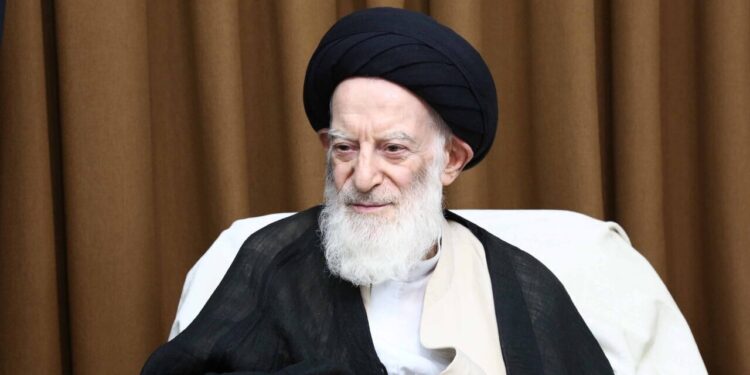
Grand Ayatollah Sayyid Musa Shubayri Zanjani, one of the most senior Shia religious authorities and a leading scholar of the Qom Hawza, has passed away aged 98, prompting condolences from senior marajiʿ, scholars and Shia institutions around the world.
The eminent Marjaʿ passed away in Qom following a lifetime devoted to Islamic scholarship and teaching, bringing to a close a scholarly career that connected the contemporary Hawza with some of the defining figures of twentieth-century Shia learning.
Grand Ayatollah Shubayri Zanjani was particularly renowned for his expertise in ʿilm al-rijal, the study of the narrators and transmission of hadith, alongside his scholarship in jurisprudence, usul and hadith.
Born into a scholarly family in Qom in 1928, he studied under an extraordinary generation of scholars, including Grand Ayatollah Sayyid Husayn al-Burujirdi, Muhaqqiq Damad, Grand Ayatollah Sayyid Abu al-Qasim al-Khoei, Grand Ayatollah Sayyid Muhsin al-Hakim and Grand Ayatollah Sayyid Abd al-Hadi al-Shirazi.
He later became one of Qom’s foremost teachers in his own right, transmitting that scholarly inheritance to generations of students. Among those who studied advanced fiqh and usul under him is the current supreme leader, Ayatollah Sayyid Mojtaba Khamenei.
Grand Ayatollah Shubayri Zanjani also maintained longstanding relations with the leadership of the Islamic Revolution. He supported the movement established by Imam Khomeini and retained a close relationship with Imam Khamenei over subsequent decades. Following Imam Khamenei’s martyrdom, Ayatollah Shubayri Zanjani remembered him as an outstanding student of Imam Khomeini’s school who had devoted his life to the path with determination, sacrifice and remarkable perseverance.
Grand Ayatollah Sistani leads tributes from the Shia world
Among the most significant condolences came from Grand Ayatollah Sayyid Ali al-Sistani in Najaf, who described his passing as a “painful tragedy and a great loss”.
Grand Ayatollah Sistani remembered him as one of the great scholars and pillars of the Qom Hawza, emphasising both the scholarly works he left behind and the example provided by his conduct and religious service.
Grand Ayatollah Jaʿfar Subhani similarly described the late Marjaʿ as “one of the pillars of the Islamic seminaries”, highlighting the breadth of his knowledge across the Islamic sciences. Subhani particularly pointed to his standing as a scholar with established views in jurisprudence and firmly grounded expertise in ʿilm al-rijal.
The reaction within the seminaries has reflected his standing. Lessons were suspended in Qom, while senior teachers in Najaf also cancelled classes in mourning.
Ayatollah Alireza Arafi, director of Iran’s Islamic seminaries, invoked the narration of Imam al-Sadiq (a) that when a believing jurist dies, “a breach is made in Islam that nothing can fill.”
Iranian President Masoud Pezeshkian highlighted another dimension of the late Marjaʿ’s life, praising his “scholarship, ethics, tolerance” and commitment to preserving the purity of religion. He described his passing as an “irreparable loss” to Iran’s religious and scholarly community.
Scholarship and a life of humility
Grand Ayatollah Shubayri Zanjani’s standing rested not only on his jurisprudential scholarship but particularly on his expertise in ʿilm al-rijal.
His detailed knowledge of narrators, scholarly lineages and classical texts made him an important reference for researchers examining how the hadith heritage of the Ahl al-Bayt (a) was transmitted across generations.
This depth of knowledge was accompanied by decades of teaching, making his influence felt not simply through his writings but through generations of scholars who studied under him.
His reputation for scholarship was also accompanied by a notably modest personal manner, a characteristic repeatedly emphasised in the tributes following his death.
Mourning reaches Shia communities worldwide
The response to his passing has extended well beyond the traditional centres of Shia learning in Qom and Najaf.
In the United States, the Imam Mahdi Association of Marjaeya (IMAM) highlighted Grand Ayatollah Shubayri Zanjani’s “asceticism, humility, and piety”, recalling his concern for the poor and vulnerable and his emphasis on students of religion remaining humble and avoiding attachment to worldly comforts.
The organisation described his death as a loss for the Islamic seminaries and the wider Muslim Ummah, paying tribute to a scholar whose formidable learning was accompanied by personal simplicity and devotion.
In Britain, Ahlulbayt Islamic Mission (AIM) in London described his passing as “a profound loss for the Hawza, the institution of the Marjaʿiyyah and the wider Muslim Ummah.”
AIM highlighted his contributions to Islamic jurisprudence, hadith and particularly ʿilm al-rijal, while offering condolences to Imam al-Mahdi (aj), the scholars and seminaries, his family, students and followers.
The tributes from North America and Britain, alongside the mourning in Najaf and Qom, reflect the reach of a Marjaʿ whose life remained firmly rooted in the traditional Hawza but whose scholarship commanded respect across the international Shia community.
The passing of a generation
Grand Ayatollah Shubayri Zanjani belonged to a generation that studied directly under scholars who shaped the modern Hawzas of Qom and Najaf. Through decades of teaching and research, he became part of that chain himself.
His passing therefore represents more than the death of a senior Marjaʿ. It marks the departure of one of the remaining representatives of a generation that directly transmitted the scholarly traditions of some of the most influential Shia jurists of the twentieth century into the contemporary Hawza.
His contribution to jurisprudence, hadith and particularly ʿilm al-rijal, together with the generations of students he taught, secured him a distinctive place in contemporary Shia scholarship.