
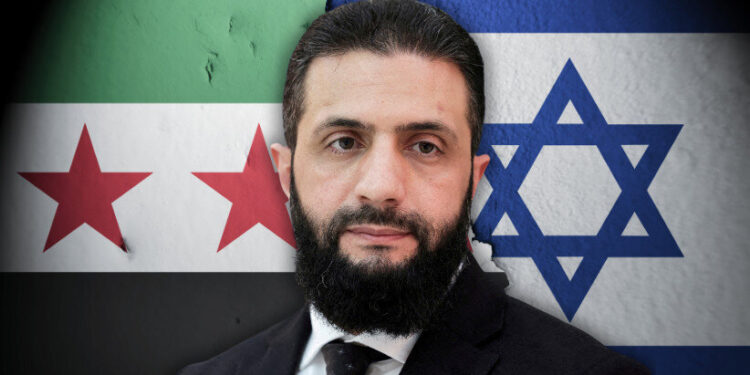
Ahmed al-Sharaa’s transformation from Abu Mohammed al-Jolani — commander of al-Qaeda’s Syrian affiliate — into a president welcomed by Donald Trump should not be understood merely as one man’s remarkable political reinvention.
It belongs to a much bigger story.
For decades, Western powers have repeatedly exploited armed Islamist movements when they served strategic objectives against governments considered hostile to Western interests. Fighters once useful against Moscow, Tehran or Damascus could later be designated terrorists, abandoned, bombed — or rehabilitated when circumstances changed.
Seen through that history, Jolani’s journey from al-Qaeda commander to Washington partner is less inexplicable than it first appears.
Today, the former jihadist is presiding over something Washington and Tel Aviv have pursued for decades: the removal of Syria from the regional front confronting Israel, the severing of Iran’s land connection to Lebanon, the isolation of Hezbollah and the integration of Damascus into an American-designed regional security architecture.
The battle was never simply over who governed Damascus.
It was over what Syria was allowed to be.
The jihadist instrument did not begin in Syria
The uncomfortable history of Western involvement with jihadist forces long predates ISIS or Jabhat al-Nusra.
During the Soviet war in Afghanistan, the United States, Pakistan, Saudi Arabia and their allies poured money, weapons and recruits into the Afghan jihad.
This is not speculation produced by America’s adversaries. Hillary Clinton acknowledged the consequences herself.
Testifying before Congress in 2009, Clinton said that Washington had to accept responsibility for helping create the forces it subsequently confronted, telling lawmakers that “the people we are fighting today we funded them twenty years ago”. She described the Reagan administration working through Pakistan’s ISI to recruit mujahideen, including fighters arriving from Saudi Arabia and elsewhere.
The following year she was even more explicit, saying: “Part of what we are fighting against right now, the United States created.” She described how Washington trained, equipped and financed the anti-Soviet mujahideen infrastructure whose aftermath helped produce subsequent jihadist movements.
That does not mean that the CIA literally sat down and formally established al-Qaeda or ISIS as organisations.
The history is more consequential than that simplistic claim.
Washington helped construct, finance and weaponise a transnational jihadist battlefield when that battlefield served American geopolitical interests. Once the Soviet Union had been defeated, the forces created and empowered by that environment developed their own organisations, objectives and enemies.
The relationship changed.
The method did not disappear.
The Afghan model returns in Syria
When war engulfed Syria after 2011, another enormous international campaign emerged to overthrow a government aligned with Iran, Hezbollah and the Palestinian resistance.
The CIA operated a covert programme to arm and train Syrian opposition forces, while the Pentagon separately spent hundreds of millions of dollars on its own train-and-equip operation.
The Pentagon publicly acknowledged supplying Syrian armed groups with large quantities of ammunition. In October 2015, a US defence spokesman confirmed that members of the American-trained “New Syrian Forces” had handed some of their US-supplied equipment to Jabhat al-Nusra — al-Qaeda’s Syrian affiliate.
Even within America’s political establishment, warnings were being sounded.
During a Republican presidential debate in 2015, Senator Rand Paul said the United States, Saudi Arabia and Qatar had poured hundreds of tonnes of weapons into the anti-Assad war. He argued that regime-change policy had created the space in which ISIS expanded and condemned the idea of supporting forces fighting alongside al-Qaeda affiliates.
Donald Trump went further during his 2016 presidential campaign.
He repeatedly called Barack Obama the “founder of ISIS”. When challenged, Trump acknowledged that he was being sarcastic — before adding that he was “not that sarcastic”. His argument was that US intervention, particularly the destruction of Iraq and Washington’s subsequent regional policies, had produced the conditions in which ISIS emerged and flourished.
This distinction matters.
The strongest case is not that every ISIS or al-Qaeda commander was secretly receiving a Pentagon salary.
It is that Western powers repeatedly armed, financed, facilitated or politically exploited militant ecosystems because those forces weakened governments Washington wanted removed — even when officials understood the danger that jihadist organisations would benefit.
And one of those men was Jolani
Ahmed al-Sharaa emerged from precisely this environment.
Before becoming Syria’s internationally recognised leader, he was Abu Mohammed al-Jolani, leader of Jabhat al-Nusra, the official Syrian branch of al-Qaeda.
His forces were among the most effective fighting organisations seeking to destroy the Syrian state that had, for decades, formed a crucial part of the resistance architecture linking Iran, Iraq, Syria, Lebanon and Palestine.
Al-Jolani later broke organisationally with al-Qaeda and eventually built Hayat Tahrir al-Sham.
Then came the transformation.
The military fatigues gradually disappeared. The revolutionary-jihadist language softened. The beard was trimmed. Western journalists were welcomed. The suit appeared. And the man once hunted by Washington was eventually welcomed into the White House.
This should not be reduced to cosmetic changes. What matters is that Jolani’s political function changed alongside his appearance.
Trump’s new friend in Damascus
The personal warmth between Donald Trump and al-Sharaa has become unusually conspicuous.
Trump has praised the Syrian leader and his government, while Washington has moved to rehabilitate Syria internationally and remove major elements of the sanctions architecture that once surrounded Damascus. In July 2026, Trump informed al-Sharaa that he intended to remove Syria from the US list of state sponsors of terrorism.
Their relationship has even developed a strangely personal character.
During al-Sharaa’s White House visit, Trump presented him with his branded cologne and sprayed the fragrance on the Syrian leader. Months later Trump sent additional bottles accompanied by a handwritten message. Al-Sharaa publicly thanked him for the “precious gift”.
Perfume is not geopolitics but the symbolism is extraordinary.
The former commander of al-Qaeda’s Syrian affiliate — an organisation Washington itself designated as terrorist — is no longer treated principally as a threat.
He is treated as a partner.
The question is: a partner in what?
Removing Syria from the Resistance Axis
The answer becomes clearer when Syria’s new regional role is examined.
For decades Syria formed the indispensable geographical bridge between Iran and Lebanon. Iranian support could move westwards through Iraq and Syria towards Hezbollah and other resistance organisations confronting Israel.
The fall of the previous Syrian order effectively severed that corridor.
That outcome is now openly celebrated in pro-Israel strategic circles.
A Wall Street Journal opinion piece published this week described al-Sharaa’s rise as a “novel opportunity” for Israel. Its central observation was revealing: Syria was no longer the logistical lifeline through which Iranian support reached Hezbollah.
The Foundation for Defense of Democracies — one of Washington’s most aggressively pro-Israel and anti-Iran think tanks — has been even clearer.
In a July policy paper entitled “Countering Hezbollah Could Bring Syria and Israel Closer”, FDD argued that Damascus and Israel now possess converging interests against Hezbollah.
It praised Syrian efforts to intercept weapons moving towards Lebanon and explicitly argued that cutting Hezbollah’s Syrian supply corridor would strengthen Israel’s long-term security.
This is perhaps the most revealing evidence of what the new Syria represents.
The same Syria that once enabled the resistance in Lebanon is now being encouraged to police the resistance’s supply lines for Israel’s benefit.
Trump wants Syria to deal with Hezbollah
Trump himself has made the expectation remarkably explicit.
In June, the American president revealed that he had discussed Hezbollah directly with al-Sharaa. He subsequently said that he had suggested allowing Syria to “take care of Hezbollah”, arguing that Damascus could do the job more effectively.
Reuters separately reported that US officials had encouraged consideration of Syrian involvement in operations against Hezbollah in eastern Lebanon, although US envoy Tom Barrack subsequently publicly denied that Washington had asked Syria to deploy forces across the border. Damascus itself has denied intending a military intervention in Lebanon.
But Syria does not need to invade Lebanon to fulfil Washington’s broader strategic objective.
It merely needs to close the border. Intercept weapons. Dismantle resistance networks. Expel Iranian influence. Prevent the reconstruction of Hezbollah’s logistical depth.
What previously required Israeli air strikes can increasingly be achieved through a compliant Syrian security architecture.
And then comes Israel
The next stage is already visible.
Al-Sharaa has publicly confirmed that his government is seeking a security agreement with Israel and has suggested that such an agreement could eventually become a gateway towards comprehensive peace.
That statement comes while Israel continues to occupy Syrian territory and has carried out repeated military operations inside the country.
Yet the response from Damascus is not a strategy of resistance.
It is negotiation.
Washington has been intimately involved in pushing the two sides towards an arrangement. Reuters previously reported that al-Sharaa was prepared to accelerate talks with Israel partly to satisfy the United States, even while seeking concessions over Syrian territory.
Once again, the broader direction matters more than whether formal normalisation arrives tomorrow or several years from now.
Syria is being moved from confrontation with the Zionist project towards incorporation into a regional order constructed around it.
The imperial objective comes into view
Look at the region as a whole and the pattern becomes difficult to ignore. Iran is being militarily and economically confronted. Hezbollah is being pressured to surrender its weapons. Lebanon is being pushed towards negotiations with Israel. Syria’s resistance infrastructure has been dismantled. The Syrian-Iranian strategic relationship has been broken. The land corridor connecting Tehran to Beirut has been severed.
And the man presiding over Damascus is simultaneously developing a relationship with Washington and negotiating a security framework with Israel.
From an imperial perspective, this is an extraordinary strategic prize.
It is also why reducing the story of Ahmed al-Sharaa to the question of whether he has genuinely moderated misses the point.
Washington does not need Jolani to become a liberal democrat. Israel does not need him to become a Zionist. They need Damascus to cease functioning as part of the Resistance Axis.
FDD’s strategists effectively say so themselves: weaken Hezbollah through Syria, close Iran’s corridor and turn shared hostility towards the resistance into the basis for Syrian-Israeli cooperation.
The objective was never simply the defeat of Bashar al-Assad.
The larger prize was the geopolitical transformation of Syria: from the central Arab link in the Axis of Resistance into a state detached from Iran, hostile to Hezbollah, dependent upon Washington and gradually reconciled to Israel.
Jolani’s greatest service to that project may therefore not have been what he accomplished as a jihadist commander.
It may be what Ahmed al-Sharaa is now trying to accomplish as president.