
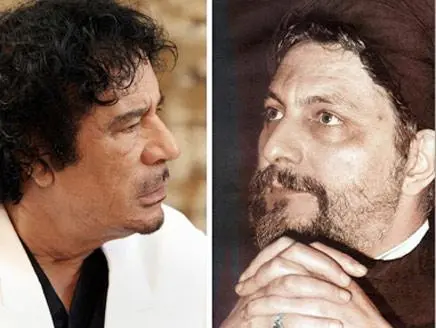
An extraordinary new account of the disappearance of Imam Musa al-Sadr claims that former Libyan ruler Muammar Gaddafi personally shot the revered Lebanese Shia leader twice in the chest during an explosive confrontation in Tripoli in August 1978.
A newly publicised testimony has offered one of the most detailed — and disturbing — accounts yet of what may have happened to Imam Musa al-Sadr and his two companions after they disappeared in Libya nearly five decades ago.
Iraqi researcher, historian and media figure Dr Hamid Abdullah claims that Gaddafi himself shot Imam al-Sadr twice in the chest on 31 August 1978, before ordering the killing of Shaykh Mohammad Yaacoub and journalist Abbas Badreddine.
Abdullah presented the account on his programme Tilka al-Ayyam, saying it originated from information allegedly obtained by Iraqi intelligence from sources connected to the Libyan security establishment under Gaddafi.
According to Abdullah, the chain of intelligence began with former Libyan colonel Salim al-Hajani, who sought political asylum in Baghdad and told Iraqi intelligence that Mohammad Ahmad al-Adl, a senior figure linked to Libyan external security, possessed sensitive information about Gaddafi’s regime.
Iraqi officials are said to have subsequently met al-Adl at the Iraqi embassy in Tunis, after which he allegedly provided Baghdad with intelligence concerning several matters — including the fate of Imam al-Sadr.
Abdullah claims that al-Adl had obtained the information from one of Gaddafi’s female bodyguards.
A dispute over Gaddafi’s ‘Green Book’
The account traces the confrontation to Imam al-Sadr’s assessment of Gaddafi’s ideological manifesto, the Green Book.
During the Lebanese Civil War, Gaddafi’s government provided financial assistance to several Lebanese organisations while simultaneously attempting to promote his political ideology across the Arab world.
Copies of the Green Book reportedly reached Lebanon and were read by Imam al-Sadr.
According to Abdullah’s account, Imam al-Sadr privately dismissed the work as lacking intellectual substance and allegedly described its author in extremely critical terms. Libyan intelligence operatives are then said to have passed those remarks directly to Gaddafi.
Imam al-Sadr travelled to Libya on 25 August 1978 after receiving an official invitation from the Libyan authorities. Six days later, Abdullah claims, Gaddafi requested a private meeting with him at the Bab al-Aziziya compound in Tripoli, without Shaykh Yaacoub or Badreddine present.
During the meeting, Gaddafi allegedly confronted Imam al-Sadr over his criticism of the Green Book.
Rather than withdrawing his remarks, Imam al-Sadr is said to have calmly maintained his position, arguing that the book contained no theory or idea of real value.
The confrontation then reportedly escalated dramatically.
Abdullah alleges that Gaddafi verbally abused Imam al-Sadr, accused him of being an Israeli agent and threw his religious turban to the ground.
Imam al-Sadr reportedly remained composed and told Gaddafi that his ultimate destination would be hellfire.
‘Two bullets in the chest’
According to Abdullah, Gaddafi then ordered guards to restrain Imam al-Sadr and remove him.
The Iraqi researcher claims that Gaddafi subsequently followed them, summoned a man identified as Hosni al-Ahrari, drew his pistol and fired two bullets directly into Imam al-Sadr’s chest.
He allegedly then handed the weapon to al-Ahrari and ordered him to kill Shaykh Mohammad Yaacoub and Abbas Badreddine, who had been detained separately.
The three bodies were then allegedly transported to Bir al-Ghanam in western Libya and secretly buried.
Perhaps the most consequential part of Abdullah’s account is his assertion that documentary evidence of the killings may still exist inside Iraq.
He claims that two documents connected directly to the affair survived: one allegedly recording that al-Ahrari had informed Gaddafi that the three bodies had been buried, and another concerning the dispatch of Libyan intelligence officers to Rome shortly after the disappearance.
Abdullah maintains that former Iraqi intelligence personnel concealed the file and that it may still be recoverable.
A longstanding case against the Gaddafi regime
The allegation that Gaddafi’s regime was responsible for Imam al-Sadr’s disappearance is not new.
Imam al-Sadr, Shaykh Yaacoub and Badreddine were last seen during their official visit to Libya in August 1978. The Gaddafi government subsequently claimed that they had departed Libya for Italy, an account disputed by Italian investigations.
The Lebanese judiciary later accused Gaddafi and other senior Libyan officials of involvement in the disappearance and issued warrants in connection with the case.
Former members of Gaddafi’s inner circle have also given accounts suggesting that Imam al-Sadr was killed inside Libya, although different witnesses have offered conflicting versions of precisely how and where it occurred.
What makes Abdullah’s testimony different is its extraordinary specificity: it identifies Gaddafi himself as the gunman, provides an alleged motive for the confrontation and names individuals said to have participated in the killings and disposal of the bodies.
The BBC’s 2025 investigation
Abdullah’s account emerges almost exactly a year after another major investigation attempted to uncover Imam Musa al-Sadr’s fate.
In September 2025, BBC Eye Investigations examined evidence surrounding a mysterious body discovered in a secret Tripoli morgue following the fall of Gaddafi in 2011.
Lebanese-Swedish journalist Kassem Hamadé said he had been shown a refrigerated room containing 17 bodies and was told that one of them might be Imam al-Sadr. The corpse reportedly attracted his attention because of its unusual height and facial resemblance to the missing Shia leader.
The BBC subsequently subjected a photograph of the corpse to facial-recognition analysis at the University of Bradford, with the results suggesting a possible resemblance to Imam al-Sadr.
The investigation nevertheless failed to establish conclusively that the body was his, and Imam al-Sadr’s family rejected the suggestion, maintaining that evidence available to them indicated that he remained alive after the photograph was taken in 2011.
The BBC investigation and Abdullah’s latest testimony therefore present two very different possible accounts of Imam al-Sadr’s fate.
Abdullah alleges that Gaddafi personally shot him twice in the chest in August 1978 and subsequently ordered his body buried in western Libya. The BBC investigation, meanwhile, examined the possibility that his remains had been preserved for decades in a secret Tripoli morgue.
The contradictions underline how far the case remains from being conclusively resolved. Yet the emergence of two major investigations in successive years also demonstrates that, nearly half a century after Imam al-Sadr disappeared, the search for what happened inside Gaddafi’s Libya is far from over.
Imam al-Sadr’s family questions the account
The new claims should nevertheless not be treated as established fact.
Abdullah himself has acknowledged that his account requires further investigation and comparison with the extensive body of evidence accumulated during the decades-long case.
More significantly, Imam al-Sadr’s son Sayyid Sadr al-Din al-Sadr reportedly contacted Abdullah after the programme and challenged the information presented, saying that much of it did not correspond with the facts known to the family.
The official Imam al-Sadr institutions continue to describe him and his two companions as having been forcibly disappeared in Libya, maintaining the long-standing position that their ultimate fate has not yet been conclusively established.
The newly published account therefore does not close one of the Shia world’s most painful unresolved cases.
It does, however, raise an obvious question: if documents relating to the alleged killings really remain hidden in Iraq, can they now be located, authenticated and made public?
For almost 48 years, the disappearance of Imam Musa al-Sadr has remained an open wound for Lebanon and particularly its Shia community. The latest testimony adds another potentially important lead — but until the alleged Iraqi intelligence documents are produced and independently verified, the final fate of Imam al-Sadr, Shaykh Mohammad Yaacoub and Abbas Badreddine remains unproven.